
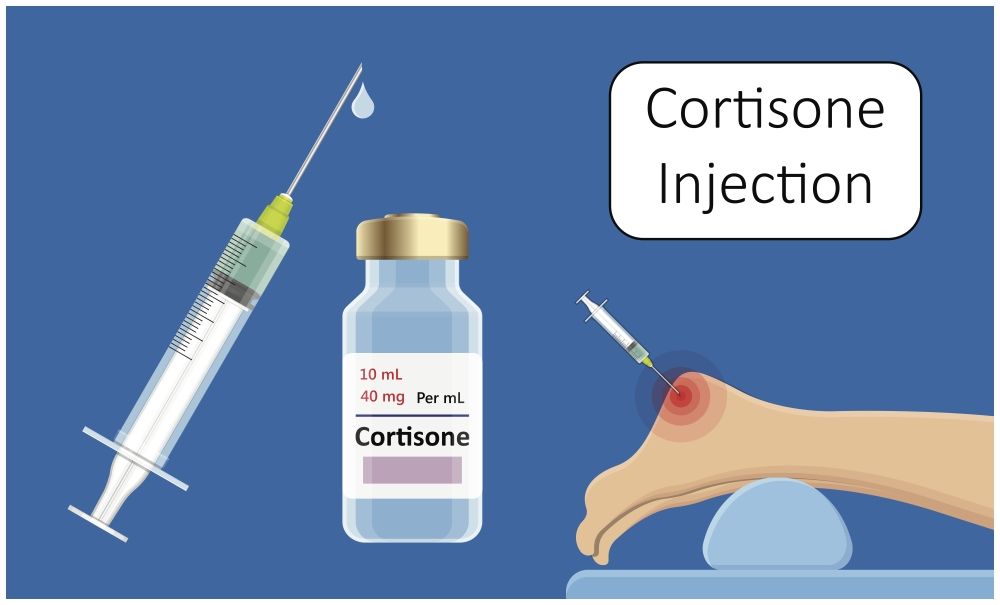
We use cortisone injections for arthritis and tendonitis, and one of the most common questions is how long it takes for a cortisone shot to work. This page answers that directly, then covers the other questions people ask before and after a cortisone injection.
How long does it take for a cortisone shot to work?
Generally, a cortisone shot takes about 1–2 weeks to start working. If you have an event coming up — a marathon or a sports final — we usually suggest having the shot at least a week beforehand, so the timing works in your favour.
It’s important to know that cortisone can cause a flare of pain in the first few days before it helps (more on that below), so you should rest for a few days after the shot. The maximum effect builds over about 2–4 weeks — so if it hasn’t worked immediately, don’t give up; we usually wait a full 4–6 weeks before judging whether a shot has worked.
(For how long the relief then lasts, see our dedicated page on how long a cortisone shot lasts.)
Why does a cortisone shot work?
Cortisone is a corticosteroid — a drug that reduces inflammation. Joint and tendon problems cause inflammation, which leads to pain and limits activity. A cortisone shot dampens that inflammation. The effect is temporary: cortisone doesn’t cure arthritis or tendonitis, but the pain-relief window makes rehab more effective.
Do cortisone shots hurt?

Usually, there’s some discomfort, but with a local anaesthetic, most people tolerate it well. Ultrasound guidance helps direct the cortisone precisely, reducing discomfort and improving results.
Tell your doctor your medical history
Cortisone shots are very safe, but some conditions — diabetes, cancer, or HIV — can interact with cortisone, so tell your doctor. (We cover cortisone and diabetes in detail separately.) Modern evidence suggests you generally don’t need to stop a blood thinner such as warfarin for a joint injection, but always check with your doctor.
Why might a cortisone shot not work?
A shot can fail for a few reasons: the wrong diagnosis, the wrong injection site, or poor needle placement (which is why ultrasound guidance matters), and failure to follow up with proper rehab.
The cortisone flare: pain after a cortisone injection
The commonest side effect is a cortisone flare — increased pain in the first few days. A flare usually starts after about 6 hours and lasts up to 5 days (one study found an average of about 4 days). If it happens, rest from aggravating activities, ice the area for about 10 minutes every few hours, and take ibuprofen 400mg up to three times a day. Ibuprofen and other anti-inflammatories help settle a flare. Can a cortisone flare last for 3 weeks? Yes, but it’s rare, so you should speak to your doctor.
(For more on rest and recovery afterwards, see Do You Need to Rest After a Cortisone Injection?)
What are the side effects of a cortisone shot?
Cortisone shots are generally very safe, but possible side effects include a rare allergic reaction, infection (around 1 in 100,000), temporary skin thinning or discolouration (reduced with ultrasound), bleeding into a joint, a temporary rise in blood sugar in people with diabetes, and the cortisone flare. There are also concerns about repeated injections — frequent cortisone can weaken tendons or harm cartilage, which is why we use cortisone sparingly. We cover the risks in full on our page. Are corticosteroid injections bad for you? page.
How many cortisone shots can you have?
There’s no strict limit, but there are concerns about repeated injections in the same area. If a first shot doesn’t work, we may repeat it after 6–8 weeks; if a second doesn’t work, we don’t recommend a third in the same spot.
Can you have two cortisone shots at once?
Yes, but cautiously. Because a shot can cause a flare, we avoid injecting both sides (both knees or hips) at once — doing one side at a time, a week apart, means you can still function if one flares. Two shots together also means a bigger cortisone dose, which can cause side effects such as tiredness in older patients.
Frequently asked questions about a cortisone shot
Can you drive home after a cortisone injection?
Wait at least 15 minutes (a shot can briefly make you lightheaded). For hip, knee, or foot injections, or a shoulder/elbow/hand injection that limits your control, we advise not driving yourself — arrange a lift, taxi, or public transport.
Is a cortisone shot safe in pregnancy or breastfeeding?
Cortisone is generally considered safe, but we avoid it in pregnancy unless necessary and suggest speaking to your obstetrician — see cortisone shots while pregnant. Breastfeeding is fine: only a tiny amount reaches breast milk.
Can cortisone shots affect your periods?
Yes — more often than people expect. A study found that a steroid injection disturbed the menstrual cycle in just over half of women (heavier or lighter bleeding), usually for one cycle only. Women on the contraceptive pill had less variability.
Do cortisone shots cause weight gain?
Generally, no weight gain is associated with high-dose cortisone tablets over weeks, not with one or two injections. See whether cortisone shots cause weight gain?
Can a cortisone shot cause hiccups, flushing, or insomnia?
Yes, all are recognised but uncommon, and short-lived (1–2 days). Facial flushing is more common in women, especially with triamcinolone, and settles on its own (an antihistamine helps).
Can you get a cortisone injection after a joint replacement?
We generally advise against injecting a replaced joint because of the infection risk.
Do cortisone injections damage joints?
One study found frequent injections harmed knee cartilage — but those patients had eight injections over two years. One or two injections are safe and effective; the concern is repeated injections into one joint. More on this: Are cortisone injections bad for you? page.
Can you have a cortisone injection on blood thinners?
Probably yes. A study showed bleeding wasn’t increased regardless of blood-thinner dose, so you usually don’t need to stop or reduce it for a joint injection — but check with your doctor.
Are cortisone shots better under ultrasound?
Yes — good evidence shows ultrasound guidance improves accuracy and effect. See a doctor experienced in ultrasound-guided injections.
Can a cortisone shot help bursitis?
Yes. Bursitis often follows tendonitis (for example, trochanteric bursitis from hip tendonitis). Cortisone helps with the pain, but it should be combined with physiotherapy.
What happens if a cortisone shot hits a nerve?
It causes brief burning, pins and needles, or numbness, usually settling within minutes. If the nerve is bruised, symptoms can last days to weeks but generally recover.
Do cortisone shots make you tired?
One injection is unlikely to. Two or three at once can briefly suppress the body’s own cortisol production, causing fatigue, especially with the more potent triamcinolone.
Can a cortisone flare last for 3 weeks?
Yes, it’s possible but rare. You should speak to your doctor if the cortisone flare lasts for 3 weeks or longer.
Are there alternatives to cortisone?
Yes. Hyaluronic acid (such as Durolane) often provides longer-lasting relief in arthritis; PRP provides long-term relief for knee arthritis and some tendons. Combining HA and PRP may be better still, and Arthrosamid is promising for knee arthritis. We compare the two main options directly on cortisone vs hyaluronic acid.
Final word from Sport Doctor London about how long a cortisone shot takes to work
A cortisone shot is a safe, effective procedure for many musculoskeletal conditions, but it matters who does it. It usually takes about a week to start working, with the full effect by 2–4 weeks. See a medical doctor experienced in ultrasound-guided injections.
To book a cortisone injection with Dr Masci in London, contact the team here or view the injection fees.
Answered my question & more..Rest for 2 days after..Also may be pain or flare for 2 days…
yes
Im on XERALTO blood thinner, is it safe to get a cortisone injection for tendon tear
Yes blood thinner. I often tell patients not to take the dose on the morning of the injection although tendon injection is a lower risk. Lorenzo
Very interesting. Lots of good information. Do you have any information about a series of gel shots given in 5 days? Wondering how long this relieves the pain?
hi John,
Thanks for the comment. Gel shots usually last from 6-12 months. Nowadays, I tend to use the concentrated form so you only need one shot. eg ostenil plus durolane
After the knee shot I’m having lot of pain coming from my thigh it hurts bad is this normal?
Thank you for your comment. It can be normal to have pain from a cortisone shot that extends a little from the injection site – so for the knee – pain can extend to the lower part of the thigh. However, this pain should settle after 3-5 days.
Hi Dr Masci,
I received a cortisone injection (December 13th, 2021) into the joint of my big toe after breaking my sesamoid bone over a year ago. I’m a professional dancer and the lack of joint movement has caused me a lot of pain. As soon as the injection was done it felt numb for about 5 mins and then started swelling and itching (the itching stopped about 15 mins later). Now 4 days later I still have on and off swelling and the joint is still very stiff and causing me pain and seems no different than before. I have read on other websites that swelling should stop after 2-3 days and effects should start to kick in and i’m worried that it’s still no different on day 4.
Hi, Often cortisone flare and stiffness can last up to a week. And the positive effect of cortisone can take up to 2-3 weeks to start. So i wouldn’t give up hope yet.
Cortisone shot is such a helpful injection to get relaxed from the pain. The information shared here is so useful to learn so much about cortisone shots. Thank you for sharing the information.
I got a Cortisone shot in my right hip today about 11am, when will I know if it worked?
Hi Steve, probably in 2-4 weeks.
I have t seen reports on back pain
Can you take a cortisone shot if I have cll cancer and taking calquence medication?
Hi Manuel, Generally I tend to be a little more cautious about a cortisone shot if a patient is having chemotherapy – due to the concerns about the increased risk of infection. However, I still do injections if clinically indicated.
Hi, I got a cortisone shot in my shoulder 5 days ago. The shot was very painful. After the initial pain I was pain free the entire day. On the next day my resting shoulder was aching and I couldn’t raise my arm without pain. I called the doctors office and they said to rest it and ice it.
Five days later I don’t have the range of motion I had before the shot. Before the shot I could raise my arm straight up, then I would feel pain. Now, I can’t raise my arm at all without pain.
I’ve had two cortisone shots in the past. One I had years ago, and the other maybe a year ago. I have never felt this pain and discomfort before. The pain is not as bad as it was 4 days ago, but my should is worse off.
Could the PA have botched to shot? I asked about using ultrasound, but she said she didn’t need it. I spoke to her today and she said that she injected into a small space, and give it some time. She mentioned injecting it into the acromial space, but I don’t remember the exact term she used.
Does it sound like my shoulder will ever get back to at least how it was, or is my should severely limited now? I’m 65 years old. Thanks
Thank you for your comment. Unfortunately, despite previous successful injections, you can sometimes experience an adverse reaction to a cortisone injection. Generally, these reactions are short-lived and do not last for greater than 1-2 weeks. If you’re concerned, I’d get in touch with your PA again.
Very interesting read. May I ask a question? I am having injection tomorrow in my 3 middle toes (both feet) & wondered if I will be able to wear the footwear I go in or, should I take slippers with me ?
slipper would be better for a few days. Lorenzo
How long after receiving a cortisone shot to the knee can you start Monovisc injections?
good question. No definite rules but I wait about 4-6 weeks before hyaluronic acid injections.
Lorenzo
Hi Pain in knee 2 weeks after cortisone injection ( apart from the,odd twinge, pain free the past 2 weeks) Does that mean it’s failed to work Thanks
Hi Gae, i’d give the cortisone a little more time – i usually say 4-6 weeks from the time of the injection. Lorenzo
Thanks!
I had steroid injection 4 days ago for gluteal retinopathy and bursitis. I still have pain especially putting weight on my leg.Is this usual, should I rest it and what should I expect? Your advice would be welcome
Hi Ann, yes cortisone flare can last up to a week. The average is 4 dayshttps://www.ncbi.nlm.nih.gov/pmc/articles/PMC5444605/
I suggest ibuprofen and rest from activity until it settles.
Alrhough I feel fine, I have a frozen shoulder and biceps tendinitis which have improved with PT, but it has been recommended to get a cortisone shot in my shoulder. I’m very nervous about side effects – I take 100mg spironolactone for hormonal acne, are there any adverse reactions or warnings about reducing efficacy of either? Thank you!
I would recommend a hydrodistention for your frozen shoulder see my blog
https://sportdoctorlondon.com/shoulder-hydrodilatation-injection/
This procedure should settle both problems – you can reduce the dose of cortisone if you’re concerned about side effects – I’d suggest 20mg of Depo-medrol .
i have hip pain that started all at once about 2 weeks ago. Since I’m still in treatment for breast cancer, 2 more doses of Perjeta,, and the pain is going to my knee where I’ve had the joint replaced, they did xrays and a bone scan. It showed arthritis. Like I don’t have enough going on. lol She gave me 5 days of a po steroid. It didn’t help at all. She mentioned an injection. I’m terrified of that. I had several injections in my knees before the joint replacements. They didn’t help. Is the injection something you would recommend?
Hi Rita, If you’ve had the knee replaced with a prosthesis then I would not recommend an injection due to the increased risk of infection. The knee pain may be coming from your replaced knee joint or your hip. See this blog that outlines symptoms of hip arthritis
https://sportdoctorlondon.com/injections-for-hip-arthritis/
Dear Dr Masci,
I think you are amazing to be answering all these questions. I have had some satisfaction after reading people’s questions & your replies.
I injured my back after falling down two flights if stairs when I was young and have lower back problems & worn facet joints worse on the right. Over the past 3yrs suffering badly from bursitis with pain radiating down my thigh & around my right knee, this is effecting everything I do now.
Three yrs ago I had a cortisone shot in the upper thigh & that did not work. Two years ago the Dr put the cortisone injection right into my hip joint and kept going in & in & I almost passed out with the pain & the nurse had to stay with me for half hour..that did not work. This year for four months now the pain is worse than ever before, I can’t do my regular walking, I can’t drive very far as can’t sit for long and the pain keeps me awake at night, so decided to go elsewhere and try another shot. This time it was ok & for first few days thought it was great, but that was almost 4wks ago and though a lot better than before, still in pain if I walk too far or drive for long & especially pain at night. Dr said to come back after 6 wks if still bad what do you think? Thankyou
Hi Glenda, It’s difficult to know what is driving your pain. it could be your hip or low back. The key is finding someone who can give you a better idea as to where the pain is coming from. Sometimes, however, it can be difficult.
Lorenzo
Hi There – I have chronic shoulder bursitis and I had a steroid injection in my shoulder using ultrasound three weeks ago on 4th November. The pain disappeared after two weeks and I was able to use my right arm again. Unfortunately last week the pain has come back again. I am back on painkillers etc. I am not sure if I am supposed to use my arm at all until it heals or should I be able to do things with my right arm now. For the past few days I have not used my arm at all and it seems a bit better but not great. Can you give me some advice please.
Hi Dianne, as a general rule, you should use an injection to help with exercise. Injections are not the cure for most cases of shoulder pain. I’d suggest seeing a therapist to take you through an exercise program starting very light and progressing slowly. In general, rest will not make your shoulder pain better. Lorenzo
Hi sir, its been 5 weeks I had steroid injection on my right shoulder as I was having supraspinatus tendinosis.
There is no pain when I lift things, or hit hard at the pain, I get pain only when I raise my hand side wards or when I raise arm for throw (throw arm) . can you please help me what should I do here ?
Shall I wait for few more months or ice the area with exercises or take second shot?
Hi Dhruv,
I would strongly recommend you see a physical therapist or physiotherapist to help you with a strengthening program. Ice will help. I’d suggest you avoid a second shot unless you feel the pain creeping up again.
Hi Lorenzo
I had an injection in my knee a week ago and I am still in agony. It’s like a dull toothache. The pain comes in waves that’s the only way to describe it. In bed at night is worse. Is this normal or hasn’t the injection worked. Thank you
Hi Julie – a little unusual. I’d speak to your doctor.
Thank you so much for your great advice. Had a cortisone shot on top of my foot due to mild arthritis and tendernitis. 1st day no pain and 2nd day alot of pain. Each day pain decreases. Your article states it takes 4 to 5 days to work.Feel great now. Thank you for explaining it. I do have a bone spur on side of foot..no pain…don’t understand that.
I had a 3rd steroid injection in my shoulder 4 days ago and resting it has been difficult due to Xmas holidays. I have sharp pain down my arm when I make any movement which hasn’t yet eased, is this likely a flare? I think I only had discomfort for a couple of days previously but this is very painful during any movement now.
Hi Marianne, almost certainly yes. Steroid flares can last up to a week. But i would try to see a doctor if the pain doesn’t settle.
Hi Dr. Masci, I had an injection to the tailbone part of my spine one week ago and my pain decreased starting the next day. I went back to physical therapy today and afterward the pain returned. Could the physical therapy have ruined the positive effect of the injection? Is it temporary? Should I stop PT for awhile? I would greatly appreciate your insight and advice. Ed
Hi Ed, I suggest you don’t exercise while you still have pain. Generally, we think that exercises during pain after a cortisone injection prolongs the cortisone flare and might lessen the positive effects of a cortisone injection.
Hello
I hope you can help. I am a 71 year old female. My doctor has suggested an injection in my right shoulder. I’ve had an ultra sound which has revealed a torn tendon, tendinitis, and severe bursitis. I have arthritis in the shoulder as in most of my joints. Is it worth having the injection? From all the previous comments it seems a bit futile. I am very scared of injections . Should I request alternative suggestions from my doctor. I don’t think he inte ded to use ultrasound to guide the I jectiin as per the vt. I wish you a very Happy New Year and thank you for your te.
Hi Lesley, I’ve just written a chapter in a book (due to be released) on shoulder injections. Putting the evidence and my anecdotal experience together, I think a cortisone injection would be my preferred first option. I have had patients who have responded very well to one cortisone injeciton. if you have arthritis of the shoulder, then I’d recommend an injection into the joint (although if you have a full-thickness tear, then it doesn’t really matter where you inject the cortisone. However, I would strongly advise having it done under US guidance. Next option would be durolane (hyaluronic acid) Regards LM
Hi,
I received a cortisone shot in my left deltoid at the ER for a pulled muscle in my neck on Dec 1 that caused a lot of pain. Immediately following the shot, the neck pain went away but I lost significant range of motion in my left arm at the shoulder. No pain or tingling. I couldn’t lift my arm straight up. MRIs and EMG test done the next couple days came back negative. I’ve since been going to physical therapy and have made some, albeit slow, progress. Now when I lift my arm straight past 45 degrees up, my shoulder hunches upward to compensate for the muscle weakness. It looks like I’m shrugging on one side. Again, no pain or numbness. My PT says my rotator cuff muscles were rendered inert and I’ve been trying to get them to work again. My deltoid does feel heavy and tight constantly. Do you think this is a cortisone flare up? It’s been a long month and I just want to know if there is light at the end of the tunnel.
Thank you and Happy New Year
Hi Tony, you may have developed acute brachial neuritis or parsonage turner syndrome see this blog :
https://sportdoctorlondon.com/parsonage-turner-syndrome/
I’m not convinced the cortisone shot was the cause.
If it is brachial neuritis, then your prognosis is excellent – about 90% chance of full recovery.
I’m scheduled for my first cortisone injection in my back on Friday. (22nd)
I am really nervous and scared…
Should I have someone to come to my appointment?
hi Jennifer, As a general rule, yes. Although i’m sure you’ll be fine. Lorenzo
Hi,
I had a cortisone injection 4 days ago. I have Bursitis and cuff tear? My shoulder is still sore. How long will it take for the injection to work.
P.S. it was done under ultra sound. And I have been resting as that’s what I was told to do. Still can’t put my arm behind my back without it hurting
Thx Angie
Hi Angela,
Average flare lasts 4 days and the effect of cortisone starts in 1-2 weeks – so still time.
LM
Hi if I get a shot in my foot will I be able to run at a tryout in a week?
Hi Tim, it depends on what structure you have injected. Generally, small joints should be ok after a week but you need longer if you inject a tendon – usually 10-14 days. Lorenzo
Hi, I had a fall from electric bike 3 weeks ago and got my right arm and shoulder got injured; 11 mm calcification got build up on supraspinatus terminal which is causing me pain and restricted range of motion. I’m seeing physio too but to help with pain is it good idea to go for cortison injection because It is not chronic and also acute injury; cortison might help me to recover soon and in this time calcification will resolve too.
Hi, I think an injection would be reasonable. But you need to make sure you don’t have a full-thickness tear of the tendon – caused by the fall. if you do, then surgery may be needed.
https://sportdoctorlondon.com/bursa-injection/
Lorenzo
Hi – I have had a cortizone shot in my shoulder and i have suffering from non stop hiccups. This is day 2 …. anything to be concerned? thank you in advance. all your responses are very helpful.
hi, yes hiccups are an uncommon side effect of cortisone. However, it should settle in the next few days and is not of concern (apart from being very annoying).
Lorenzo
Hello , I injured my finger at work a few weeks ago and now I’m told I have trigger finger . After a visit to an orthopedic surgeon , suggested by my primary care physician he prescribed me a medication and told me if the medication doesn’t work , (we’ll it didn’t work) then I will give you a cortisone injection . My questions are is this safe and how long after the injection can I return to work at 100% after receiving the injection ? How long before I can return to work because at my place of work I can not return to my job at 100% , there is no light duty at my workplace . And could the injury have caused my trigger finger ?Thank you for your time.
Hi, please see this blog on trigger finger:
Generally, I recommend at least 3 days of rest after a trigger finger injection. As a rule, I find these injections very effective at relieving symptoms but the recurrence rate is reasonably high. Side effects are minimal and risk low. I’d have it done under US guidance.
https://sportdoctorlondon.com/trigger-finger-injection/
Hi, I had cortisone into my shoulder for bursitis 7 days ago. All has gone great but I jarred it today and my neck has stiffened up again. Do you think this will have undone the injection? Thanks for your help
Hi Adrian, I don’t think so. The maximal effect of cortisone injection is between 2-4 weeks. Lorenzo
Hi Lorenzo. I had a fall and grabbed a handle to save myself. My shoulder took full body weight. That was September. In January I lifted my dog and hurt my back. My whole back went into spasm and twisted my spine. Doc put me on Valium which sorted out my back muscles then gave me cortisone injection for my shoulder 10 days ago. I have no idea of what damage has been done but I have a pain down my neck into my back/shoulder blade. I cannot lift arm to side past shoulder or put it up my back. I am trying to exercise when I have good days but then I am in pain the next day. Should I be resting this for a little while or am I best to keep on stretching and exercising? Doc said I can have another cortisone injection 4 to 6 weeks from last one if needed
I would always be supportive of exercise over rest. I think rest places you at risk of other problems such as frozen shoulder or general deconditioning.
Thank you so much for your reply. I am doing exercise 3 times a day then ice. Just wasn’t sure if I should have been doing them just now. No pain no gain right! Appreciate your advice
Hello, I received a cortisone injection in my arthritic right hip two weeks ago. I was pain free and able to walk normally for those two weeks. I was thrilled! Now the pain (and limping) has returned. I read your responses to other patients that it may take two weeks for the steroid injection to work. Will the steroid continue to work or do you think that is all the pain relief I will experience? Thank you.
hi Kathleen, hard to know. As a general rule, I suggest waiting a full 4 weeks before coming to a conclusion as to whether the cortisone will continue to work.
Lorenzo
Hi there,
I had a cortisone injection for bursitis in my left hip,it was good for a couple of days,but it’s back again,can I have another injection
Hi Marianne, Generally, I wait about 6 weeks before injecting again. Lorenzo
Hi Doctor Masci,
I had a total hip replacement 3 months ago, just winding down my outpatient PT. My knee, on same leg, slowly developed increasing pain so same doctor injected a cortisol shot. It’s 2 weeks today and I still have erratic pain in my knee, sometimes achiness to severe pain. My follow up with doc is in 4 more weeks, but I feel it’s not helping as much as I thought. Unless I take 3 ibuprofen an hour before walking I am limited in my walk. What is going on with this knee? I’m so utterly frustrated and thought that by now I’d be well on my way back to my old self.
I think you need to give the cortisone a little bit more time to work. The maximum effect of the cortisone shot is ususally 2-4 weeks. At 6 weeks, you’ll know whether the cortisone shot has worked. Lorenzo
I have severe pain in shoulder 2 days later from cortisone shot there, would it be ok to take a ketorolac for pain?
so yes – ketorolac or any other anti-inflammatory – Aleve, ibuprofen etc Lorenzo
Dear Dr Masci, Thank you for all the above helpful information.
I suffer with all over chronic pain , and have Lumbar and Cervical spinal Stenosis with generalized OA and Degeneration from my neck to my feet. I have had 2 Lumbar surgeries.
I get Steroid injections approx every 4 months from my Rheumatologist. These injections are small amounts of steroid into (mostly) soft tissue/trigger points, depending on the most painful areas at the times of the appointments.
The last 4 appointments have focused on one very painful arthritic foot, and a very painful shoulder girdle – posterior and anterior.
Is it safe to continue getting these injections long term, as its the only short term relief I get. The foot is getting more difficult to walk on.
hi Gem, You need to be careful with long-term use of cortisone. I’d speak to your doctor. it depends on the dose and frequency. Lorenzo
Last may 2021 had both hips injections it help for 8 months now go for my 2nd injections today March 17 2022
Help me for 8 months hope help again. I let you know…every body is DIFFERENT
Yes, some patients respond to cortisone better than others. The average though is only a few months. LM
I had a reaction from a steroid injection yesterday.
I was given an injection in both hips.
This morning I awoke with a headache & my face was blushing. Also had a low grade fever.
Called doctor & was told he was going to call me back but never did
Is this to be expected?
so facial flushing is common, especially in women. This effect lasts for 1-2 days and then settles. It is thought to be due to a histamine-like reaction of cortisone.
Low-grade fever is less common but could be due to a cortisone injection especially if you’ve had two injections.
Lorenzo
HI Dr Masci,
So impressed with your knowledge and responses here. I had a steroid injection last week for acute sciatica caused by ‘Small left posterolateral L5/S1 disc protrusion with likely left S1 nerve root irritation. Mild mid and lower lumbar facet joint OA’ quote from MRI report. Steroid has given me immediate relief and i am starting to be able to walk again. literally couldin’t walk over the last month.
My question is – how do i improve and make sure i never get to that point again? what type of exercise, supplements, behaviours can help? im a 57 yr old women in a sedentary job who likes walking but is not sporty. Appreciate any guidance you can give me and pls give me a link to your book as well. Many thanks in advance
Thank you for your comment. I’m glad you find it useful.
i’d suggest you adopt a healthy lifestyle – mild to moderate exercise – either Pilates or Yoga (gentle) are fantastic. Maintain a good weight and stop smoking (if you smoke). Exercise should always be progressive – start light and slowly increase to give your body time to adapt. Good luck!
LM
Thank you so much for these shared comments and answers. I had cortisone shot today with ultra sound
I having a lot of pain and was scared 😱 but after seeing it can last around 4 days I feel more reassured I should be ok by the 22nd of April when I have surgery to reverse a colostomy and remove gallbladder! Please pray it will give me relief thank you and God Bless 🙏
Hello,
I appreciate the knowledge and support that you provide on this site.
I have Degenerative Arthritis (since my 20’s). I’ve had injections in both hips & several in the ankle w/out issue 20yrs ago. In between Ive had other replacements & surgeries.
At 45yrs old I had 2 cortisone injections in my Lumbar Spine (L4 &L5 area) for my leg (w/ a mild flare response) that required nothing more than rest and ibuprofen & had good results. Then branch chain nerve block injections (6) in the mid-lumbar area for burning pain. They were ineffective, but caused no flare issue.
However, in my shoulder joint (needs to be replaced), I’ve had 2 in office cortisone injections w/ sonogram. Within 2hrs of each shot, pain grew in intensity until all i could do was let out screams. Any movement/touch set off more excruciating spasms & screams of terror. The 2nd injection episode sent me to the ER.
Do you have any idea why my shoulder joint injections would result in such a violent pain response? The first injection did finally give me relief after a week of being on high powered drugs for the reaction. It lasted 3 months. Its been a week since the 2nd injection and I’m still in pain from the initial flare response. I am not currently on any regular pain meds.
Hi Elizabeth, Sorry to hear about your problems.
Your experience is a little unusual especially as you had the injections with a sonogram.
You should ask your doctor about the type of cortisone he/she used. When using a drug called Depo-medrol, some patients develop a severe flare. Perhaps your doctor may consider using a different type of cortisone? (another option is Kenalog).
Lorenzo
Had a shot on a week ago, still in a lot of pain. And cannot put any weight on knee. This is very frustrating
I have chronic back issues with stenosis and sciatica. I had a previous injection years ago to relieve pain down the back of my leg and down to the shin. That one worked beautifully. no pain for years. But had another injection at the same site recently and instead of having improved results, the shot re-initiated the pain. Why??
injections introduce an element of unpredictability. Sometimes, injections don’t work and in a few cases, they can make your pain worse.
I’m a 60 year old female and had a hip injection by a physiatrist using ultrasound. Immediately a headache began up my neck and over my entire head and into my eyes. No pain, bruising or swelling in injected hip. Dr’s receptionist suggested I go to urgent care clinic where they asked for a urine sample. When I crouched to get the sample I experienced excruciating pain in the injected hip. Felt like something slid out of place. I slowly moved positions until searing pain decreased. This was day 2. I was given Tylenol 3 for the headache and my face began to flush and burn. Not sure if it was from the injection or codeine. I have had pain since, that radiates into my knee and groin like before the injection. This is day 7. Flushing is gone. Could I have messed with the injection by crouching and pulling something? Should I be resting by lying or sitting? Should I see a physiotherapist to work on what I did? I’m very discouraged.
Flushing is a common side effect after a cortisone injection. Headache is unusual.
if the pain is not settling (or getting worse), I’d suggest contacting your doctor.
Hi, I’ve been suggested a cortisol injection in my shoulder for calcification- I’m
46 and trying to get pregnant… I feel like that might be a bad idea to have the injection?
I would speak to your obstertican. But as a general rule, I suggest avoiding medication in the first trimester. However, if you have severe pain, I think the potential benefits outweigh the small risks.
Dear Sir, l have had a cortisone injection in my knee, may l still used Ibuprofen gell on that knee please .
Yes you can use both treatments together. LM
I read all your comments doctor and all I can say is that you may be an excellent excuse for a trip to London. You are more knowledgeable then the hundreds of drs. I have seen. I had a laminectomy in my back in2019. Have had back issues since I played professional tennis when I was young and slipped a disc going for a backhand. Ever since then it’s been chiropractor injections therapy walking. The surgery went well and nothing was put in place of the disc. No spacer no metal! Had it done at Duke University. Now May bursitis on my hip is acting up again and I took an injection today. Can only use 1/2 cc because of reaction that gives me super steroid flush and Bpressure high. The dr. Uses dextramethasone. Kenalog lasts longer but last time he used that I didn’t sleep for 2 days. My question is there is a doc that says I need to have a spacer slipped into where the one disc was removed and the go in through the side not to injure the nerves again in the back. Another dr. His parter says I need rod metal plate screws etc. I don’t think so. !!!! No way. I don’t want metal I my back . That’s when things to to go bad. It’s one surgery after that then another and another. The dr that Judy removed the ruptured disc suggest this least invasive approach. It’s been fine for 4 yrs. The dr. Today he thinks it the facet king causing the back pain and wants to try injections in there before for epidural. Also will get a new mri befor anything! Sorry so long Dr. But do you see stints ?? You have an office in Linda??very impressed with you!thanks!
Thank you for your comments. As a general rule, I would avoid spacers in the back – they’ve been used in shoulders and feet previously without good results.
Hi, I had cortisone injections 1 week ago. One in bursa (front muscle of the hip/groin) and another directly into my hip bone/joint.
I had horrendous pain in my right bum cheek the first morning after the injections.
Bruising started about 48hrs after the injections. It is comfortable to leave my leg straight, but cannot turn my leg outwards, due to pain.
I still can’t bare my full weight on the leg/side I had the injections.
Is this normal? & when can I expect to be “back to normal” and is this something I need to call the drs about?
I don’t believe there is any infection, as not hot or pussing etc. Just bruising getting worse.
Hi Jo, yes this reaction is a little unusual one week after an injection – best to speak to your doctor. LM
I have a full tear in my rotator cuff resulting from a fall. I have excellent range of motion. My only problem is dull pain in my shoulder and more significant pain in the biceps area with certain activity. The latter pain source is a puzzle to the surgeon.
So far, the cortisone shot seems very effective, I am hopeful that I can manage with these injections as needed. The surgeon assured me that there would be no lifetime limit. This is in contradiction to the limits I see in the literature about cortisone shots in general. Maybe there is a reason that the shoulder area is exempt from such restrictions? I look forward to your opinion.
H Jean, I think if your surgeon is not going to repair your tendon, a cortisone injeciton every 6-12 months would not be unreasonable. The question is whether the positive effect of cortisone will reduce over time. It might or might not.
LM
Will a cortezone injection help my planter fasciitis
see this blog https://sportdoctorlondon.com/plantar-fasciitis-injection/
In summary, yes, but not without risk.
I had the cortisone injection in my foot arch 4 days ago, and was relieved for about 5 minutes before the pain starts(severe). I had to be given a pain relieve shot. Now the pain is not as severe as before but still worse than before the cortisone shot as I can’t bear weight on the foot.
Is the immediate flare normal?
Hi,
Generally, for a cortisone flare, pain starts after 6-12 hours nad lasts for up to a week. Pain after 5 minutes is atypical for cortisone flare.
LM
It’s now 6 days , and the pain is still not going
hi lorenzo, how long does cortisone take to work for a chronically inflamed nerve?
Hi Sophie,
Generally, a cortisone injection for an inflamed nerve takes up to a week to start working (sometimes after a few days and occasionally after a few weeks).
Hi! I am a 21 yr old who has had a hip replacement & have had hip pain again for the past 7 months.. they have done all sorts of testing & haven’t found an answer.. the next step is a cortisone injection. Is it a big risk to do an injection with having had a replacement done?
If you’ve had a hip replacement, I generally advise against an injection into the joint due to the increased infection risk. However, you could have an injection around the iliopsoas tendon if this structure is irritable.
LM
I am a 17-year-old who has had chronic pain in my right big toe for 9 years and I am getting my shot done on Wednesday next week. How long does the shot take to happen and how long should it take for the injection to start working? I have also heard that it can cause bad reactions to your skin is this a likely side effect?
please see this blog for more information on timing, duration of action annd what to do after the procedure:
https://sportdoctorlondon.com/how-long-does-a-steroid-shot-last/
https://sportdoctorlondon.com/do-you-need-to-rest-after-a-cortisone-injection/
As I outline in my blog, side effects include skin changes. But performing the procedure with ultrasound improves accuracy and reduces the risk of skin changes.
Good luck.