

Trigger finger is a common overuse condition affecting one or more fingers or thumbs. One of the most effective treatments is a steroid injection. But how effective is a trigger finger injection, and when should you have one?
A trigger finger injection is the main first-line treatment when simple measures fail. If one or two injections don’t work, the next step is a percutaneous trigger finger release — covered in our companion guide.
What is a trigger finger?

Trigger finger describes painful clicking as the finger tendon passes through tiny pulleys at the base of each finger. The thumb, middle, and ring fingers are most often affected. It starts with focal pain on movement. As the tendon swells, a click develops, and eventually the tendon can get stuck in the bent position. Symptoms are often better in the morning and worse by the end of the day.
Some people describe the finger locking when holding something; others feel pain straightening it.
Trigger fingers are more common in older people and in those who do repetitive finger movements — tradespeople, office workers, and climbers. Medical conditions that cause swelling, such as diabetes or thyroid problems, raise the risk.
How do we diagnose trigger finger?
We combine clinical assessment with ultrasound. Imaging shows thickening of the A1 pulley — if it exceeds 0.63 mm, we regard the pulley as abnormal. Occasionally, other pulleys are involved. As the condition progresses, the tendons thicken into nodules. Ultrasound also detects secondary causes such as bony spurs and finger-joint arthritis.
Trigger finger vs carpal tunnel
These can be hard to tell apart. Trigger finger pain usually focuses on one finger, while carpal tunnel syndrome affects more than one and brings numbness, tingling, and hand weakness.
How do we treat trigger finger?
Reducing excessive finger movement — at work or in sport — lowers pain and swelling. A hand therapist helps with stretching and strengthening, and can make a small splint to reduce pressure on the tendon from the A1 pulley. An anti-inflammatory gel at the base of the finger sometimes helps too.
What happens when simple measures fail?
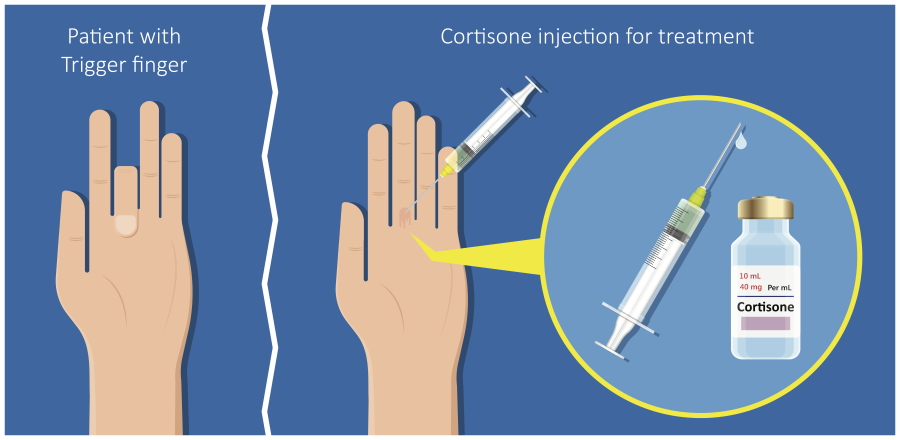
When simple treatments fail, a trigger finger injection can help. We inject a small dose of cortisone under the thickened pulley, above and below the tendon sheath. Recent studies show excellent results. If pain persists, we sometimes repeat the injection about eight weeks later. We generally perform ultrasound-guided trigger finger injections.
A single corticosteroid injection can relieve up to 90% of cases, sometimes for years. Diabetic patients have a lower success rate, around 60%.
What are the side effects of a trigger finger steroid injection?
Although the dose is low, possible side effects include a cortisone flare, infection, skin thinning, and tendon weakening. Significant side effects are rare, and injections are usually well tolerated.
Does ultrasound make a difference?
Ultrasound serves three roles in a trigger finger injection. First, it confirms the diagnosis by showing the thickened pulley. Second, it guides the needle to the right spot above and below the tendon sheath. Third, ultrasound-guided trigger finger injections improve accuracy and effectiveness, placing the cortisone correctly and reducing side effects.
Ultrasound also targets the right problem. If the A1 pulley is very thickened, injecting above and below it works better. If the tendon itself is inflamed, injecting the tendon sheath may be all that’s needed.
What about percutaneous trigger finger release?
When one or two injections fail, a percutaneous trigger finger release or open surgical release can give permanent relief. The percutaneous technique uses a specialised needle to release the A1 pulley without cutting the skin or requiring sutures, thereby reducing costs and speeding recovery.
We consider this more invasive option for trigger fingers that fail simple treatments and one or two cortisone injections. Dr Masci performs percutaneous trigger finger release under ultrasound guidance in selected cases.
Frequently asked questions about trigger finger injections
Can trigger finger resolve without treatment?
Yes. One study found 16% of trigger fingers resolve without treatment.
Is pain after a cortisone shot for trigger finger common?
Yes — people often report pain for up to three days. An ultrasound-guided injection may reduce post-injection pain through better accuracy.
Is a cortisone shot in the thumb pulley possible?
Yes. Trigger thumb is common, and an ultrasound-guided trigger thumb injection is straightforward and effective.
What steroid is used for trigger finger injections?
We generally use Depo-Medrol, as it has fewer skin and soft-tissue side effects.
What is the usual trigger finger steroid injection dose?
We advise Depo-Medrol 20 mg and avoid Kenalog (triamcinolone) due to its more pronounced skin side effects.
Can you have too many cortisone injections for trigger finger?
Possibly. One study found that more than three cortisone injections can reduce the success of a later open release, so three is a sensible limit. Beyond that, a percutaneous release is usually the better next step.
How long after a steroid injection does trigger finger improve?
Usually 5–7 days, though it can take up to two weeks, with the peak effect at about 4–5 weeks.
What diseases are associated with trigger finger?
It’s more common in diabetes, rheumatoid arthritis, gout, and thyroid disease — up to 20% of people with diabetes develop it. Recurrent trigger finger warrants checking for an underlying condition.
Is shockwave therapy effective for trigger finger?
Yes. One study found that shockwave therapy produced results similar to a cortisone injection, making it an option when the tendon is significantly thickened.
Can hyaluronic acid be used for trigger finger?
Yes. One study found hyaluronic acid to be as effective as cortisone at six months, though cortisone worked faster and was more effective at three months.
How effective is open surgery for trigger finger?
Surgery is definitive — cutting the A1 pulley through a small incision — but the complication rate is up to 17%, including more hand therapy or injections (14%), more surgery (2%), and CRPS (0.2%). It’s reserved for cases that fail all other treatment, and a percutaneous release is often the less invasive alternative.
Final word from Sport Doctor London about trigger finger injections
Trigger finger causes pain and clicking at the base of a finger or thumb. Simple treatments — rest, hand therapy, anti-inflammatory creams — help many people. An ultrasound-guided trigger finger injection is very effective, and more than one may be needed. In stubborn cases, a percutaneous trigger finger release is the next step.
To book a one-stop trigger finger assessment and ultrasound-guided injection with Dr Masci in London, contact the team here or call +44 (0) 203 488 0350.
Good info
Nice article. But, I would like to know whether the effect of cortisone injections are long lasting.
hi – yes good question. We don’t have long term data for injection after trigger finger (or at least, I’m not aware of long term data). Lorenzo
Thank you for this information. I had ultrasound guided steroid injection 2 weeks ago for my trigger thumb. The stiffness and complete inability to bend my thumb improved this week (week 2). I can slightly bend my thumb now, but my thumb still “clicks” locks when I try to bend more fully. I read another article which suggests that mechanical locking only resolves around the 3 week mark. Is this your experience in treating similar patients? Thank you in advance and greetings from Sydney, Australia.
Hi Jenny, Yes – the maximal effect of cortisone occurs at about 4-5 weeks so your thumb will continue to improve for a few more weeks. The clicking is related to the tendon swelling – which is improved by cortisone. LM
Just to clarify for anyone else reading these comments, I have swelling and thickening of the A 1 pulley at the base of my thumb. At the time of writing my comment, I had no idea that you were from Australia! Best wishes for your career in London! Australia has lost out on your skills! Obrigada!
I just had an injection this morning for trigger finger (my first time for this) but my Dr. left so quickly afterwards that I didn’t get a chance to ask how long before my finger starts to work better, a few hours, a few days???
Hi Penny – generally cortisone starts working within a week – sometimes a bit earlier and sometimes a bit later (2 weeks). Lorenzo
I received an injection yesterday and like the previous post, my Dr left the room too quickly to answer any questions. When he injected my hand he said “I know it’s in because I heard the tendon pop”. Can you explain what that means? I have had surgery on my right hand for this condition, but hope that the cortisone shot will work with the left hand.
Often during injection of trigger finger, you can feel a pop as the injectate is forced through the tight space caused by the thickened pulley.
Hi, I have just been seen by the consultant, I have lost the ability to bend my little finger and my ring finger locks when a slight fist is made. I have other issues with c6 c7 c8 vertebrae narrowing leading to neve damage, which they think is the cause of loss of little finger bending.
I was then given a steroid injection into the lower part of my ring finger, others have mentioned having ultrasounds/scans should this have been done before an injection was carried out? Should I do any exercises to help ease the pain and movement, doctor left straight after the injection without any advise for aftercare. Many Thanks
Ultrasound does not need to be done in all cases. But I think ultrasound has advantages including confirming a diagnosis and improving accuracy.
Yes, I would perform hand therapy to improve the effectiveness of an injection.
Lorenzo
I had a cortisone shot for trigger finger 2 weeks ago however where they stuck the needle is very painful can hardly touch that area any thoughts?
Sometimes, the injection site can remain sensitive for weeks. I’d speak to your doctor if the sensitivity does not settle within another 1-2 weeks.
Hello
I had cortisone shots for both carpal tunnel and trigger finger in my right hand four days ago. The trigger finger is in my middle right finger. About 45 mins after the injections, my entire hand was hurting really bad. I could not use it to do anything from making my sandwich for dinner that night to opening and closing doors. It was slightly better by noon the following day, about 20 hours after the injections. I iced a lot and also began an oral corticosteroid. By 48 hours a lot of the discomfort subsided but I’m still having a hard time with my right index and middle fingers. I can’t pick certain things up with my right hand, such as my phone, without a sudden sharp shooting pain in these fingers. I can’t completely straighten them out without the sharp pain. I can’t even use my thumb to type this without feeling a sharp pain . Opening and closing doors is still causing those same “zingers” as does washing my hair, brushing my teeth, pouring a glass of milk ect…. Is this normal? Or should I contact my doctor sooner than the six week check up?
I should also note my injections were not done with guided ultrasound. He also didn’t mention I’d lose the ability to use my hand for certain things after the shots. We even talked about what I do for work. He knew I 100% use my hands all day and said nothing about possibly being unable to perform certain job duties in the following days. He also gave me no aftercare instructions.
It is common to have a flare – sometimes lasting for up to 7 days.
I’d contact your doctor after the 7th day if not settling.
See this blog for more information on flare:
https://sportdoctorlondon.com/how-long-does-it-take-for-a-cortisone-shot-to-work/
Hi, I had a cortisone injection today for a trigger finger and found out later that day that I’m booked for TKR IN 3 and a half weeks time. Will it still be able to go ahead?
You should be fine – as long as you don’t have a cortisone injection into the knee joint.
Is a hand compression glove (copper) effective for thumb arthritis or trigger finger?
Perhaps – I’d give it a try.
Hi, I had a cortisone injection 7 months ago, but the trigger has returned. Can the second injection of steroid damage the tendon?
I generally recommend a repeat injection if the first one was effective.
LM
My brother had a cortisone injection in both hands yesterday for trigger finger to both middle fingers of his hands.
He said the pain was absolutely excruciating and he was almost in tears.
Today he cannot bend one of his fingers affected.
Has other people experienced this?
Hello
I had a steroid injection in my index finger to sort a trigger finger. It occurs only when I play the clarinet. The injection worked for a few weeks but the condition returned. Would a second injection be fully successful?
Hi John,
I’d often try one more cortisone injection. Sometimes, I consider a percutaneous needle procedure to ‘cut’ the A1 pulley using a special needle (as outlined in the blog). Your other option is open surgery to cut the A1 pulley.
Lorenzo
My thumb still feels numb after steroid shots and spread to my first finger numb is that normal and it’s 6 hours ago I got the steroid shot on my thinner “trigger finger” is that normal to feel numb that long?
Hi Missy,
It depends on the type of local anaesthetic used. For short acting anaesthetic like lidocaine, the numbness lasts for a few hours but sometimes up to 6 hours. For longer acting anaesthetic, the effects last for about 6 hours and occasionally longer than 1 day. If your symptoms don’t settle within a few days, I’d contact your doctor.
Lorenzo
Lorenzo
Sounds to me like a percutaneous needle might be the best 1st option, as it directly resolves the dysfunction causing the issue. Is there a reason this doesn’t make sense?
BTW, I have trigger finger on my left hand, and my ‘walk in clinic’ doctor has just recommended steroid injection, and suggests surgery is not a good option.
Hi John, I usually recommend a simple cortisone injection first as some patients get a total cure with an injection. Percutaneous needling is a more advanced procedure with slightly increased risks (such as nerve damage).
Lorenzo
Sounds like I was lucky… My physician assistant injected the steroid into my thumb and then we talked a bit about the after effects and recovery time. She said she heard a pop and that was a good sign . We also talked about the option of surgery down the road. After the injection, My thumb generated its own heat as if I had one of the hot hands packets inside it. It’s been very stiff and hard and painful to bend unless I’m holding the base of my thumb. I’m hoping for great results, like many of the other people who commented mentioned. Good luck to all!