

Many people spend hours each day using a computer mouse. It’s essential for both work and leisure, but repetitive mouse use can lead to thumb pain — a complaint we often hear in sports medicine clinics. If your thumb hurts from mouse use, it helps to understand the possible causes, how to assess it, and — most importantly — what to do about it.
This guide covers the common causes of thumb pain from mouse use, how to tell them apart, the ergonomic changes that help, and when to see a doctor.
Common causes of thumb pain from mouse use
When someone has thumb pain from using a mouse, it’s worth working through the possible causes systematically.
De Quervain’s tenosynovitis
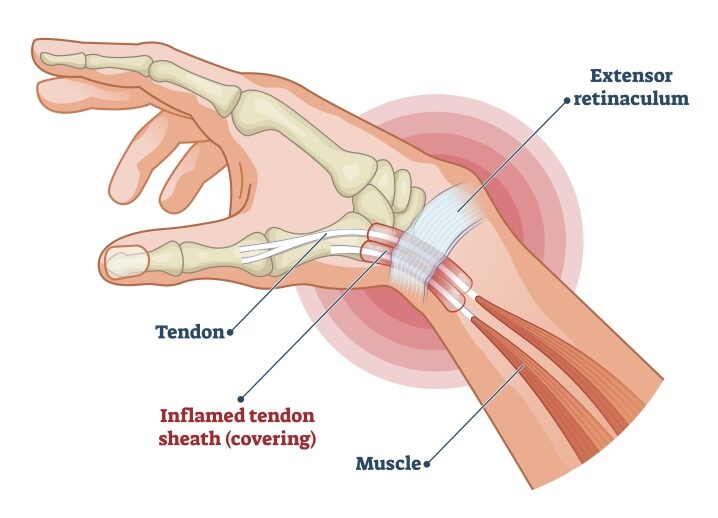
Swelling of the tendons at the base of the thumb. Pain is at the base of the thumb and can radiate to the thumb side of the wrist; it is worse with gripping, pinching, or thumb movement. There’s tenderness at the base of the thumb and a positive Finkelstein’s test (pain when you tuck the thumb into a fist and bend the wrist towards the little finger).
Thumb CMC joint osteoarthritis
Osteoarthritis of the first CMC joint causes a deep, aching pain at the base of the thumb, with stiffness or weakness when pinching or opening jars. There’s tenderness over the joint, and sometimes grinding (crepitus) at the base of the thumb.
Trigger thumb
Caused by thickening of the A1 pulley at the base of the thumb. People notice catching or locking when moving the thumb — sometimes it gets stuck bent — with painful popping on bending or straightening.
Wartenberg’s syndrome (radial nerve branch)
Irritation of the superficial branch of the radial nerve causes tingling, numbness, or burning over the back of the thumb, sometimes spreading to the index and middle fingers, often aggravated by wrist or forearm movement.
Flexor or extensor tendonitis
The thumb tendons can swell after prolonged mouse use, causing pain with resisted thumb movement and tenderness along the tendons. Occasionally tendonitis reflects an underlying inflammatory arthritis, which needs an ultrasound scan and blood tests.
Carpal tunnel syndrome (less often isolated to the thumb)
Pain, numbness, and tingling, mainly in the thumb, index, and middle fingers, typically worse at night or with prolonged wrist positions.
How a doctor assesses thumb pain from mouse use
A structured assessment pinpoints the cause. Your doctor asks about the onset, character, and location of the pain, and what makes it better or worse — including whether it’s clearly linked to mouse use. Examination looks for swelling, deformity, or muscle wasting, with palpation of the thumb joints, tendons, and wrist, and special tests (Finkelstein, Grind, Tinel’s). Watching how you use the mouse reveals ergonomic problems. Imaging supports the diagnosis — an X-ray for thumb joint arthritis, and an ultrasound or MRI for tendon inflammation.
How to fix thumb pain from mouse use
For most people, simple changes settle the pain — and they’re worth trying early.
Change your mouse and setup (ergonomics)
Ergonomics is the first and most important step:
- Try a vertical mouse or a trackball. A vertical mouse keeps the wrist in a more neutral “handshake” position; a trackball lets you move the cursor with little thumb or wrist movement. Both reduce the repetitive thumb load that drives the pain.
- Size the mouse to your hand — too small a mouse forces a pinched, clawed grip.
- Keep the wrist neutral, not bent up or to the side, with the forearm supported and the mouse close so you’re not reaching.
- Lighten your grip and your click. Many people grip and click far harder than needed.
- Move the mouse from the elbow, not by flicking the wrist and thumb.
Activity modification and breaks
Take regular micro-breaks — a short pause every 20–30 minutes — and vary your tasks so the thumb isn’t doing the same movement for hours. Keyboard shortcuts reduce mouse use. If the pain is acute, a few days of relative rest, ice, and an anti-inflammatory gel over the sore area help settle it.
Stretches and strengthening
Gentle thumb and wrist stretches, and later strengthening, help — ideally guided by a hand physiotherapist, who can also tailor your ergonomic setup. A simple thumb splint can rest the joint or tendon during flare-ups, particularly for De Quervain’s or CMC arthritis.
When simple measures aren’t enough
If the pain persists despite these changes, treatment is directed at the specific cause — for example, an ultrasound-guided cortisone injection for De Quervain’s, CMC arthritis of the thumb, or trigger thumb, which can be very effective when conservative measures fail.
Frequently asked questions about thumb pain from mouse use
What’s the best mouse for thumb pain?
There’s no single answer, but a vertical mouse or a trackball helps most people because both reduce repetitive thumb and wrist movements that cause the pain—sizing the mouse to your hand and keeping the wrist neutral matter just as much as the type of mouse.
Will thumb pain from a mouse go away on its own?
Often, yes — if you change the setup and reduce the load early. Mild, recent pain usually settles with ergonomic changes, breaks, and a short rest. Pain that persists beyond a couple of weeks or accompanies locking, numbness, or weakness should be evaluated.
Is a vertical mouse or a trackball better?
Both help in different ways. A vertical mouse keeps the wrist in a neutral handshake position; a trackball minimises whole-hand movement, which can suit thumb-base problems. It’s worth trying each to see which feels better for you.
When should I see a doctor about thumb pain from a mouse?
See a doctor if the pain doesn’t settle within a couple of weeks of ergonomic changes, if there’s locking, catching, numbness, tingling, or weakness, or if it’s stopping you from working. These point to a specific cause — such as De Quervain’s, thumb arthritis, or a nerve problem — that benefits from targeted treatment.
Can using a mouse cause thumb arthritis?
Mouse use doesn’t directly cause arthritis, but in someone already developing thumb CMC joint arthritis, the repetitive pinching can aggravate the symptoms. Good ergonomics and load management help manage it.
Final word from Sport Doctor London about thumb pain from mouse use
If your thumb hurts from using a mouse, take it seriously — especially if it persists or worsens. The common causes are De Quervain’s tenosynovitis, thumb arthritis, nerve irritation, and tendonitis, all of which respond well to early treatment. Ergonomic changes, activity modification, and — where needed — targeted injection therapy are the keys to relief. If symptoms persist despite simple changes, a thorough assessment can identify the cause and guide you back to pain-free work.
To book a one-stop thumb and hand assessment with Dr Masci in London, contact the team here or call +44 (0) 203 488 0350.
Leave A Comment