
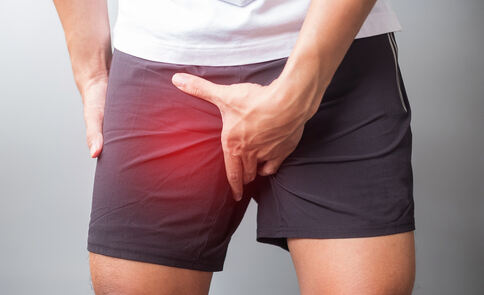
Most people recover from an inguinal hernia repair without any lasting trouble. For a significant minority, though, pain carries on well after the wound has healed — and when it does, the cause is often one of the small nerves that run through the groin. This kind of pain can be confusing and frightening, not least because the operation was supposed to fix the problem, not create a new one. The good news is that persistent pain after an inguinal hernia operation is well recognised. We can usually identify the cause and treat it. This page explains why pain happens after an inguinal hernia operation, why so much of it is nerve pain specifically, how we go about finding the source, and the full range of treatments — with particular attention to the ultrasound-guided options, including nerve blocks and nerve hydrodissection, that can settle nerve pain without further surgery.
How common is pain after an inguinal hernia operation?
Inguinal hernia repair is one of the most frequently performed operations worldwide. So, even though it’s uncommon, it affects many people. Estimates are that around 10–16% of patients have pain six months or more after their repair. A smaller group—1— 2%— describe pain after an inguinal hernia operation severe enough to be disabling.
Two things are worth noting. First, pain after an inguinal hernia operation tends to decline over time: many people with discomfort in the early months improve substantially between three and six months. Second, risks of chronic pain increase with people who have high pain levels in the first days after surgery; younger age and a repair for a recurrent hernia.
Why does chronic pain after hernia repair happen? Two different kinds
Pain after an inguinal hernia operation broadly comes from two sources, and telling them apart guides everything that follows.
Nociceptive pain comes from the tissues themselves — the normal inflammation of healing, the body’s reaction to the mesh, a stitch pulling on muscle or the pubic bone, or tension in the repair. It tends to be a deep, aching, dragging discomfort that is worse with activity.
Neuropathic pain comes from the nerves. It has a different character: burning, shooting, or electric-shock-like, often with numbness, pins and needles, or skin hypersensitive to light touch or the waistband of trousers. It may radiate into the scrotum or labia, the upper inner thigh, or the base of the penis. Specific movements can trigger it, such as standing up straight, twisting, or extending the hip. Neuropathic pain is most likely to persist and is the type that most needs a nerve-focused approach.
In practice, the two often coexist. A hernia recurrence, hip joint problems, or longstanding groin-tendon pain (pubalgia) can also masquerade as “pain after the operation,” which is exactly why a proper assessment comes before any treatment.
Nerve pain after hernia surgery: the three groin nerves
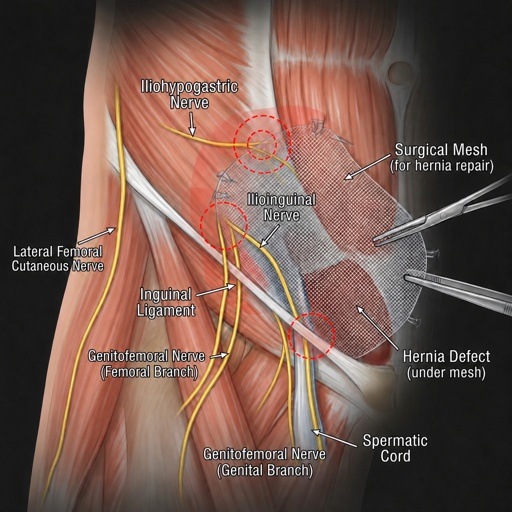
Three nerves run through the inguinal canal during hernia repair. Each can cause pain if it is irritated, caught, or cut.
- The ilioinguinal nerve is the classic because it runs right through the centre of the inguinal canal. When it is involved, pain and altered sensation typically occur over the groin crease, the front of the scrotum or labia, the upper inner thigh, or the lower abdomen.
- The iliohypogastric nerve lies just above it and supplies the skin over the lower abdomen, above the groin. Its pain pattern is slightly higher than that of the ilioinguinal nerve.
- The Genitofemoral nerve has two branches. Its genital branch travels with the spermatic cord, supplies the scrotum (or labia), and can cause testicular or scrotal pain after surgery. One systematic review reported this symptom in roughly 9% of repairs.
A nerve can be damaged in several ways: caught directly by a suture or a fixation tack, divided during surgery, trapped by scar tissue as the wound heals, or trapped by mesh that has shrunk into a ball — the so-called “meshoma.” Keyhole repairs put a different set of nerves at risk, including the lateral femoral cutaneous and femoral nerves, but share the same underlying mechanisms. The key point is that your pain and numbness pattern often points to which nerve is involved.
How we work out what is causing your pain after an inguinal hernia operation
It starts with a history—when the pain began, what it feels like, what provokes and relieves it, and exactly where you feel it. We examine the groin carefully and often map the pain, marking where it is sharp, numb, or normal. We match that map against the known three nerves. We also check for things that mimic nerve pain, such as
- Recurrent hernia
- hip pathology such as early hip arthritis or hip impingement
- groin-tendon problems
When a specific nerve is suspected, an ultrasound-guided diagnostic nerve block is one of the most useful steps. Placing a small amount of local anaesthetic precisely around a nerve is a good test: if pain settles for the duration of the anaesthetic, that nerve is confirmed as a pain source.
Treating nerve pain after hernia surgery
The guiding principle is to start with the simplest, least invasive measures and step up only if needed. Most people never reach the top of the ladder.
Reassurance and watchful waiting
Because pain often improves over the first six months, start by explaining the condition and offering simple pain relief. Encourage staying active within your comfort level. Complete rest often makes it worse.
Medication for nerve pain
When nerve pain after hernia surgery persists, the medicines that work best for neuropathic pain are different from ordinary painkillers. Options include nerve-pain agents such as amitriptyline or duloxetine. We may also use topical treatments such as capsaicin cream or 5% lidocaine patches. Although recent studies have shown mixed results for topical creams and patches, we often try them as they have minimal side effects. Moreover, there is no evidence that tablets or creams are effective as preventative treatment.
Ultrasound-guided nerve blocks
A nerve block is both diagnostic and therapeutic. When delivered accurately around a nerve under ultrasound, a block combining local anaesthetic (sometimes with a small dose of steroid) can calm an irritable nerve. In some patients, it provides relief that lasts beyond the anaesthetic itself. Blocks tailored to the individual nerve identified on examination are more useful than fixed, untargeted injections. Even when relief is temporary, a good response confirms the target and justifies moving to a longer-lasting treatment.
Nerve hydrodissection
When scar tissue traps or compresses a nerve—common after hernia surgery—nerve hydrodissection is a good option. Under ultrasound guidance, we inject fluid into the plane around the nerve to gently free it from surrounding scar and adhesions that irritate it. Ultrasound confirms we’re releasing the nerve, not injecting into it. It is a natural step to consider before contemplating an operation. Read more on our dedicated nerve hydrodissection page.
Radiofrequency and other options
If blocks and hydrodissection help only briefly, pulsed or thermal radiofrequency treatment can provide longer relief from nerve pain after hernia surgery. Nerve-stimulation techniques also exist for difficult cases. These are specialist pain-management interventions.
Surgery — the last resort
When thorough non-surgical treatment has failed, and the nerve cause is clear, surgeons may consider surgery. This usually means removing the offending mesh and performing a neurectomy. Surgeons often divide all three together because it is difficult to be certain which single nerve is responsible. This is major surgery that should be considered with a hernia or specialist pain surgeon in a centre that handles these problems regularly. Consider it only after trying less invasive steps.
Where Sportdoctorlondon fits in
Chronic pain after a hernia operation sits at the meeting point of surgery and pain medicine. We sit in the middle of that pathway: making an accurate diagnosis and delivering non-surgical nerve treatments—targeted blocks and hydrodissection—that resolve many cases without further surgery. When surgery is the right answer, we connect you with the right surgeon. Our goal is to try less invasive reversible options before anyone reaches for the scalpel again.
Frequently asked questions about pain after an inguinal hernia operation
Is it normal to still have pain months after a hernia operation?
Some discomfort in the early weeks is common and usually fades. Inflammation around the mesh can last for up to 3 months. Pain that is still present and affecting you at six months is defined as chronic and is worth having properly assessed. More than 6 months of pain affects around one in eight people after a groin hernia repair and is fixable.
How do I know if my pain is nerve pain?
Nerve pain often feels burning, shooting, or like electric shocks, and it often comes with numbness, tingling, or skin that feels overly sensitive to touch or clothing. It may spread into the scrotum or labia, the upper inner thigh, or the base of the penis. A deep, dull ache that is worse with exertion is more likely to be tissue-related. In practice, the two can overlap, so an examination—sometimes with a diagnostic nerve block—is the most reliable way to tell.
What is nerve hydrodissection and could it help me?
Nerve hydrodissection is an ultrasound-guided treatment in which a doctor injects fluid around a nerve to free it from scar tissue that compresses or tethers it. After hernia surgery, where nerves commonly get caught in scar tissue, it directly targets that problem. It is minimally invasive, can be repeated, and is a reasonable option to try before considering an operation. Whether it suits you depends on confirming that a trapped nerve is causing your pain.
Will I need another operation?
Usually not. Most people are managed successfully without further surgery, using a combination of nerve-pain medication and ultrasound-guided treatments such as blocks and hydrodissection. We reserve surgery—removing the mesh and dividing the affected nerves—for cases where a clear nerve cause hasn’t responded to other treatment.
Could my pain after an inguinal hernia operation mean the hernia has come back?
It can, and that is one of the first things we check. A recurrence can cause pain in its own right, and it needs a different treatment from nerve pain. Hip problems and groin-tendon pain can also mimic post-hernia pain. Excluding these is a standard and important part of the assessment before any nerve-directed treatment begins.
Which doctor should I see for pain after an inguinal hernia operation?
Ideally, someone who can diagnose the cause and provide non-surgical nerve treatments—distinguishing nerve pain from other causes and treating it with targeted injections or hydrodissection. If surgery becomes necessary, that same assessment means you reach a specialist hernia or pain surgeon with an established diagnosis, rather than starting from scratch.
Final word from Sportdoctorlondon about pain after an inguinal hernia operation
Pain after an inguinal hernia operation is common; it is usually nerve-related, and — crucially — it is treatable. The most important step is an accurate diagnosis: determining whether the pain comes from a nerve. From there, a stepwise plan that begins with reassurance and medication and progresses through ultrasound-guided nerve treatments resolves the problem for many people. Surgery is a genuine last resort. If you are living with groin, scrotal, or thigh pain after a hernia repair and feel you have been left to put up with it simply, you do not have to.
If you have ongoing pain after an inguinal hernia operation, Dr Lorenzo Masci can assess you in London, including diagnostic ultrasound and ultrasound-guided nerve blocks and hydrodissection in clinic, and coordinate onward care where surgery is needed. Call us on +44 (0) 203 488 0350 or book an appointment to discuss your case.
Leave A Comment