
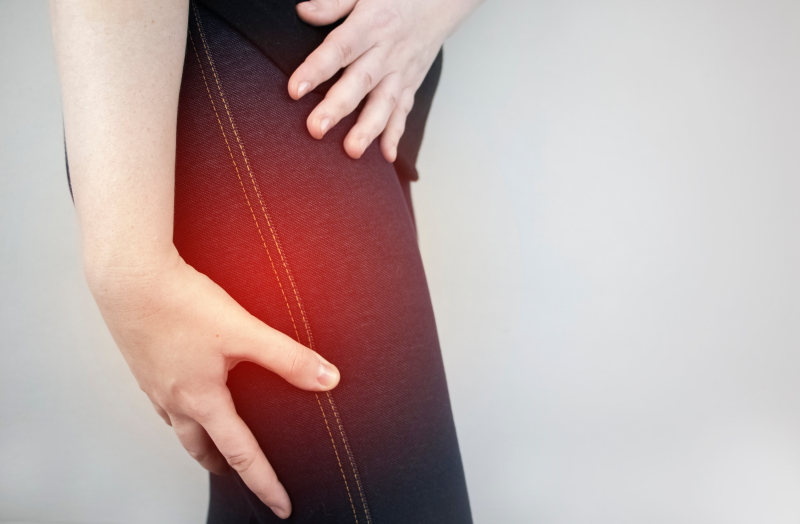
Meralgia paraesthetica causes burning pain in the outer and front parts of the thigh. It happens when the lateral femoral cutaneous nerve is trapped as it passes over the outer part of the pelvic bone. So what is meralgia paraesthetica, and how do you treat burning pain in the front of the thigh?
This is one cause of thigh nerve pain. For the wider picture, see nerve pain in the thigh and groin.
What causes burning pain in the front of the thigh?
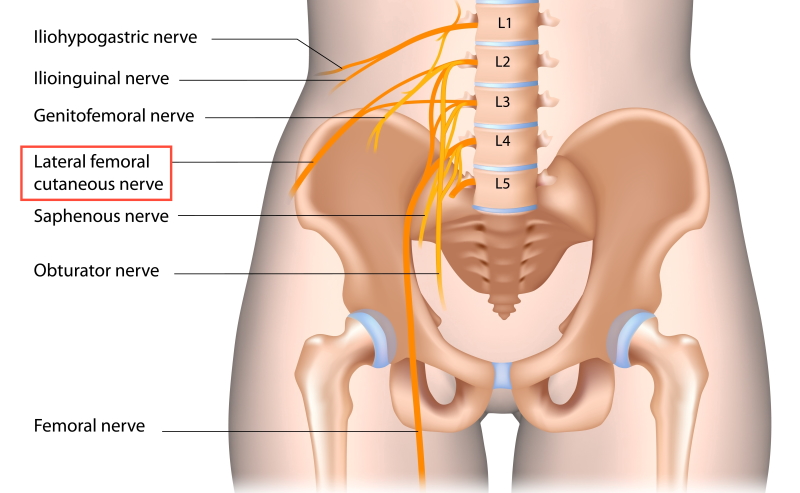
Meralgia paraesthetica comes from pressure on the lateral femoral cutaneous nerve, which supplies sensation to the outer thigh. The nerve forms from branches of the lower spine, runs through the iliopsoas muscle in the pelvis, then enters the thigh by piercing the fascia on the inside of the pelvic bone before travelling down the outer thigh. It supplies only sensation — so it doesn’t affect your ability to use your leg muscles.
Pressure on the nerve has several causes:
- Pregnancy
- Medical conditions such as obesity and diabetes
- Tight belts or clothing around the waist
- Direct trauma to the front of the pelvis
- Hip surgery, including a bone graft
Symptoms and diagnosis of meralgia paraesthetica

Meralgia paraesthetica is commonest in men aged 30–40, though it can affect any age. Typical symptoms are:
- Burning pain, pins and needles, and numbness on the outside of the thigh (some describe a numb pain)
- Sensitivity to light touch on the outer thigh
- Worse symptoms with tight clothes or a tight belt
- A recent increase in weight
On examination, there is often tenderness near the pelvic brim, where the nerve is trapped. Your doctor should also examine your spine, hips, and legs to rule out other causes. Typically, sensation is reduced over the outer thigh, but muscle strength and reflexes are normal. Tapping the nerve reproduces the pain.
We use investigations to confirm the diagnosis and rule out other causes. An ultrasound of the front of the pelvis shows thickening of the lateral femoral cutaneous nerve at the pelvic brim. We often add an MRI to exclude nerve entrapment in the pelvis or lower back, and occasionally nerve studies if another cause is suspected.
Other causes of burning pain in the front of the thigh
Many other conditions cause thigh numbness and burning: a pinched nerve from the lower spine (sciatica), spinal stenosis, quadriceps tendonitis, and iliotibial band friction syndrome. Our guide to the causes of nerve pain in the thigh covers these in full. A key clue: in meralgia paraesthetica, symptoms stay on the outer thigh — pain spreading below the knee or into the inner thigh points elsewhere.
Treatment of meralgia paraesthetica
We start with simple measures. Losing weight helps when weight gain or pregnancy is a factor, and loosening tight belts or clothing makes a real difference. Ice packs on the outer pelvis can ease symptoms, too.
If simple measures don’t help, medication or an injection may. Amitriptyline or duloxetine reduces nerve pain and numbness, sometimes combined with an NSAID such as ibuprofen.
A cortisone injection at the site of compression is often effective and can be both diagnostic and therapeutic. It should be done under ultrasound guidance for accuracy. Recent evidence suggests 80% of patients get significant relief after an ultrasound-guided injection. A higher-volume injection using dextrose — nerve hydrodissection — shows better results than a simple cortisone injection.
Finally, surgery to relieve pressure on the nerve is occasionally needed in cases that don’t respond to other treatments. But surgery is unpredictable and not always effective, so it’s a last resort.
Frequently asked questions about burning pain in the front of the thigh
Can meralgia paraesthetica go away?
Yes. About 85% of cases settle with simple treatments such as weight loss and loose-fitting clothing.
What other conditions cause burning pain in the front of the thigh?
Other causes include a pinched nerve from the lumbar spine, nerve entrapment in the groin, and inflammatory nerve conditions. With these, pain and numbness aren’t confined to the outer thigh — they spread elsewhere in the thigh or below the knee. Inner-thigh pain and numbness are usually not meralgia paraesthetica.
Is meralgia paraesthetica dangerous?
No. It isn’t dangerous. But your doctor needs to exclude other, potentially more serious causes of thigh pain and numbness.
Why does tight clothing make it worse?
The nerve passes close to the surface at the pelvic brim, so a tight belt or waistband presses directly on it. Loosening the waistline often eases symptoms quickly — which is why it’s one of the first things we suggest.
Burning thigh pain after surgery — how common is it?
More common than people think. It’s been reported after front-approach hip replacement and after spinal surgery. Treatment is the same as for other causes.
Is meralgia paraesthetica the same as a trapped nerve in the groin?
No. Meralgia paraesthetica is a thigh nerve (the lateral femoral cutaneous nerve). A trapped nerve in the groin involves different nerves — see our groin nerve pain overview. They can feel similar, which is why an accurate diagnosis matters.
Final word from Sport Doctor London about burning pain in the front of the thigh
A burning sensation on the outer thigh is often due to pressure on a nerve outside the hip. Most cases settle with simple measures, but see an experienced sports medicine doctor to confirm the diagnosis and exclude other causes.
To book an assessment with Dr Masci in London, contact the team here or call +44 (0) 203 488 0350.
Related topics:
- Groin nerve pain overview
- Nerve pain in the thigh
- Pinched nerve: what does it mean?
- Nerve hydrodissection
- Amitriptyline for pain: FAQs
- Duloxetine for pain: FAQs
Can a knee injury cause thigh pain? Also sitting for long periods of time for example at work?
yes, it’s possible for lower thigh pain. But for upper or mid-thigh pain, we need to think about the hip joint or problems in the mid-thigh. An example is hip arthritis.https://sportdoctorlondon.com/injections-for-hip-arthritis/
Lorenzo
Can acupuncture help
yes possibly. I’d try it
Can having a bilateral knee replacement cause the severe burning pain that I’m having,really bad.My left leg scar tissue turned into bone, so now I’m disabled.
Hi Mike, sometimes during a knee replacement, the surgeon can cut through nerves at the front of the knee called the anterior branch of the saphenous nerve. Lorenzo
Hi Mike, I’ve been desperately searching Dr. Google for an idea of why I’ve been suffering greatly with my upper thigh. If I adjust my body on the bed or in a recliner, it feels like someone is tearing my muscle off the bone! It’s pulling and on fire! I have a rare disease called adhesive arachnoiditis. The nerve tumor is at L54 L5 area…. it was from a failed back surgery. Do you have any ideas for what I can do? My general doctor has begun a work up on me, however, because I’m a lemon with other bodily symptoms, I believe he’s moving on from it Is there a test he could order to figure this out? Thanks!
Hi I was a fit active woman in my 70’s when I had grade 3 breast cancer I had operation and radio therapy but no chemo as they said it would probably kill me, so they put me on letrozol tablets and from there it was a downhill progression I could hardly walk every bone in my body hurt even first thing in the morning, then it caused me to have severe osteoarthritis I have since fractured my right hip and broken my left leg top bone above my knee just walking not having any falls I have now developed lower spine fusion and walk with a stoop but I have a severe burning in the top of my right leg which I presume is caused by the fusion of nerves in my lower spine my question is can I get any type of treatment for the burning in my leg
Hi Irene, yes I think you are experiencing pain from trapped nerves – most likely from the spine.
Please see my blogs on medications for trapped nerves and other treatments: https://sportdoctorlondon.com/amitriptyline-for-pain-side-effects/
I had a right hip replacement and 2 months after I had pneumonia and then covid I cough excessively for 2 months and then developed hip and inner thigh pain with burning pain down the front of the thigh, could the coughing have caused this? I have seen the orthopedic several times with a cortisone injection and then physical therapy and dry needling with little relief, I already take gabapentin for nerve pain from foot drop in my left leg, that is not helping the pain in the right thigh, what would be my next option?
It sounds like you have nerve pain:
see this blog for tips.
I’d get a second opinion.
https://sportdoctorlondon.com/overview-of-groin-nerve-pain/
Hello !
I have had pain in both sides of my groin especially during the night together with pain in my thighs & calves for the past few years. I find it hard to sleep. I have been tested for circulation but doctor says that’s ok.
I have had six surgical operations due to pregnancy & gynaecological problems. The last one was 15yrs ago. However these pains only started about 2 yrs ago.
Could this pain be due to nerve entrapment? I dread going to bed as I’m awake most of the night.
Thank you
It could be although less likely.
Groin pain is complex – see my blog on possible causes of groin pain
https://sportdoctorlondon.com/what-we-treat/hip-and-groin-pain/
https://sportdoctorlondon.com/groin-pain-in-runners/
https://sportdoctorlondon.com/overview-of-groin-nerve-pain/
I got ACL reconstruction and meniscus repair surgery done 9 months back… 5 month later it started tingling, burning and numbness in the same side of thigh. Pl. Guide me for remedies
Hi Reshma, If the burning is on the outside of the front of the thigh, you could have meralgia paraesthetica. However, if the numbness is in the middle or inside of the thigh, you could have another cause ie, from the low back. You should see your doctor to confirm a diagnosis and treatments are different.
LM