

When you sprain your ankle, you usually damage the ligaments on the outside. In some cases, though, the injury is on the inside of the ankle, to the large deltoid ligament. So, how does a sprain of the deltoid ligament happen, and how do we manage it?
What is the deltoid ligament?
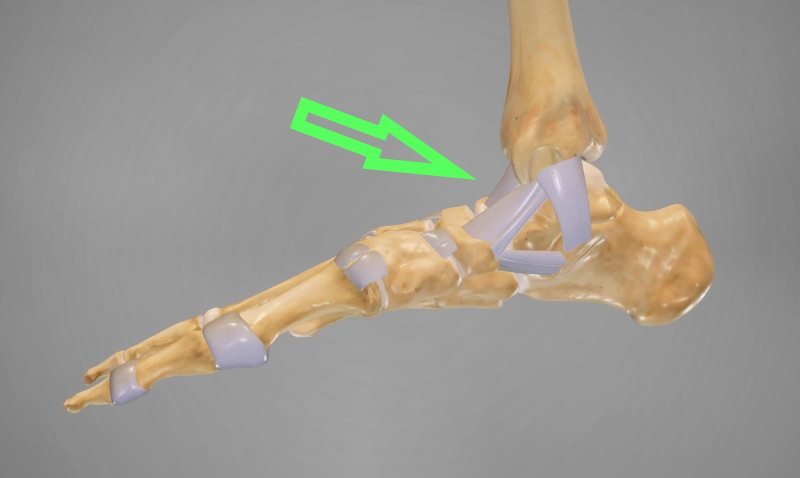
The deltoid ligament is a large, triangular ligament with superficial and deep fibres. It starts at the tip of the medial malleolus (the bony bump on the inside of the ankle) and extends to several bones within the ankle. Its job is to stabilise the inner ankle and the medial arch, and its deep fibres are the strongest.
How do you damage the deltoid ligament?
Usually, the deltoid ligament is most often injured by forceful eversion and outward rotation of the foot. Occasionally, a classic inversion injury damages the deltoid as well as the outer ligaments.
A deltoid sprain usually involves high forces, which can injure other ankle structures too — the syndesmosis, lateral ligaments, the spring ligament, and the bones on the inside and outside of the ankle. In fact, one study found that every complete deltoid ligament rupture was associated with another ankle injury — isolated deltoid injuries are rare. A deltoid sprain is common in footballers, court athletes, combat athletes, and off-road or trail runners.
Symptoms of a deltoid ligament sprain

A deltoid injury is often suspected based on the mechanism of injury and clinical findings.
People usually report pain and swelling on the inside of the ankle, and sometimes feel a “pop” at the time. If the ankle is unstable, they describe it as giving way when walking downhill or down stairs. On examination, we typically find tenderness and swelling over the deltoid ligament, with increased laxity on the inner ankle.
Imaging the deltoid ligament
We usually start with weight-bearing X-rays to rule out a fracture — sometimes a tiny fracture at the tip of the medial malleolus points to a deltoid injury. MRI then shows whether the deltoid ligament is damaged, and whether the tear is partial or full-thickness. It also reveals associated injuries — the lateral ligaments, ankle cartilage, or a high ankle sprain (syndesmosis injury).
Other causes of inner ankle pain also need to be excluded.
Treatment of a deltoid ligament sprain
Management depends on whether the injury is a partial or full-thickness tear.
Complete tears often need surgery. They’re usually associated with other serious injuries — fractures, syndesmosis sprains, and cartilage damage — which frequently need surgery too. Partial tears, by contrast, are treated without surgery.
Early on, a walking boot for a few weeks helps protect the ankle, alongside regular icing, compression, and NSAIDs to settle pain and swelling.
Once out of the boot, gentle graduated physiotherapy begins — theraband ankle strengthening, calf raises, and balance work, often started in a pool to reduce load on the ankle. Swimming, gentle cycling, and cross-training maintain fitness. A return to light running is usually possible after 6–8 weeks, with the ankle taped to limit excess pronation and protect the deltoid. Running then progresses in stages: straight-line running, changes of pace, changes of direction, and finally a return to training.
Is a cortisone shot an option for an ankle sprain?
Generally, an injection is occasionally useful. Persistent inflammation or scar tissue inside the ankle is a common cause of ongoing pain after a rolled ankle or deltoid sprain. A cortisone injection targeting that inflammation can reduce pain and allow for more rehab.
We perform these injections under ultrasound to improve accuracy and avoid important nerves and blood vessels. In one study, a cortisone shot for an ankle sprain reduced pain, improved function, and reduced the need for surgery.
Frequently asked questions about a deltoid ligament sprain
What’s the difference between a deltoid sprain and a normal (lateral) ankle sprain?
A normal ankle sprain affects the ligaments on the outside of the ankle (from rolling inwards). A deltoid sprain affects the large ligament on the inside, usually from the foot rolling outwards or twisting. Deltoid sprains are less common, often come with other injuries, and tend to take longer to settle.
How long does a deltoid ligament sprain take to heal?
A partial tear is usually protected in a boot for a few weeks, then rehabilitated, with a return to light running around 6–8 weeks. Complete tears — often with associated injuries — take longer to heal and may require surgery.
Can you walk on a sprained deltoid ligament?
Often in a protective boot early on. Significant or unstable injuries need more protection, and walking unprotected on a bad deltoid sprain risks worsening it, so early offloading and an accurate diagnosis matter.
Does a deltoid ligament sprain need surgery?
Usually not — partial tears are managed conservatively. Surgery is mainly for complete tears and the associated injuries (fractures, syndesmosis injuries, cartilage damage) that often accompany them.
Why does a deltoid sprain take longer to recover than a normal sprain?
Because it results from higher forces and is rarely isolated, it usually comes with other ankle injuries. The combination, plus the deltoid’s role in stabilising the inner ankle and arch, means recovery is generally slower than a simple lateral sprain.
Final word from Sport Doctor London about a sprain of the deltoid ligament
A deltoid ligament sprain is a relatively common ankle injury in change-of-direction sports. These injuries are often associated with other damage and take longer to settle than a simple lateral ligament sprain — so an accurate diagnosis is the key to the right treatment.
To book a foot and ankle assessment with Dr Masci in London, including in-clinic ultrasound, contact the team here or call +44 (0) 203 488 0350.
informative!!!