

We’re always on guard when an active young teen has low back pain. Unlike adults, who tend to get general low back pain, many active teens with back pain have a stress fracture in the back, also called spondylolysis or a pars defect. So, how does a painful pars defect present, and what do we do about it?
A pars defect is one of several pediatric sports injuries we assess, and one of the stress fractures we manage.
What is the pars interarticularis?
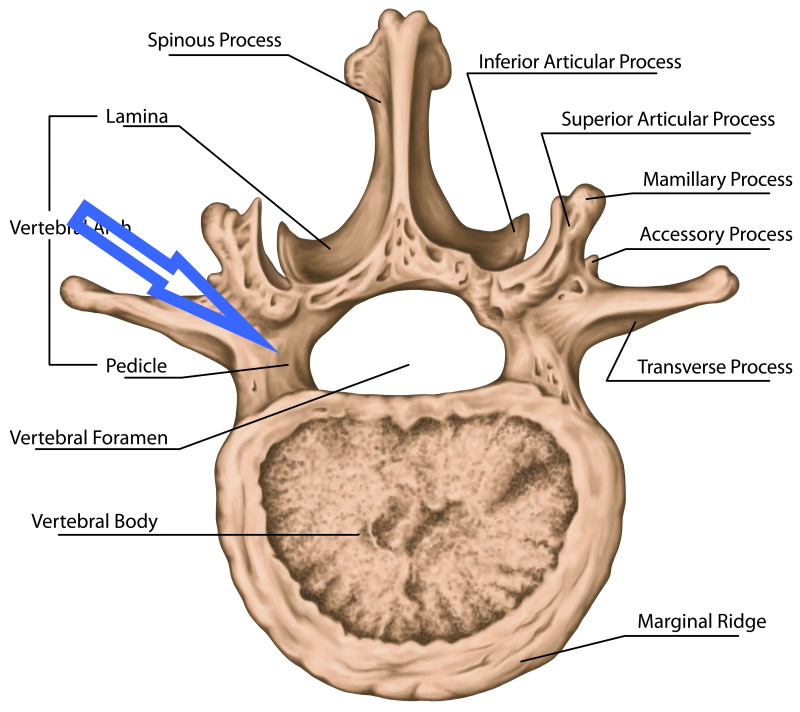
The pars interarticularis is an area at the back of each vertebra, between the pedicle and lamina. It’s vulnerable to stress because it’s the last part of the vertebra to harden during puberty — the weakest link in the spine, and the most prone to bone fatigue in active teens. That fatigue leads to a pars defect, or fracture.
What causes a pars defect?
Genetics and sport are the main risk factors.
Some people are prone to stress fractures because of their bone strength and shape, which is largely genetic — you’re more likely to develop one if a sibling or parent has. Age matters too: the younger the athlete, the higher the risk. An active 10-year-old is more likely to have a painful pars defect than a 19-year-old.
The other driver is repeated extension and rotation. Sports that load the spine this way — gymnastics, tennis, cricket, bowling, swimming, and diving — carry the highest risk, though competitive runners can develop them too.
How does a painful pars defect present?
Active teens typically report low back pain that doesn’t settle with a short (2–4 week) rest. Pain is usually worse with swimming, diving, athletics, tennis, cricket, and bowling — anything that rotates the spine — and it tends to settle with rest, then flare again on return to sport. The lower back is tender, though a study by Dr Masci showed examination alone is an unreliable indicator of a painful pars defect.
If fractures occur on both sides of a vertebra, the spine can develop spondylolisthesis. A significant slip can cause leg pain, numbness, or weakness, but most slips are small and large ones are rare.
How do we diagnose a pars defect?
An X-ray is a poor test — it misses many pars fractures. Traditionally, we used bone scans to detect high bone activity. MRI is now the test of choice: quick, easy, and radiation-free. Newer, more powerful scanners have made MRI more sensitive to bone stress, though specialised sequences are essential to raise the pick-up rate.
CT detects fractures well, but exposes young athletes to radiation, which we avoid. A specialised MRI sequence called VIBE detects fractures better than standard MRI and is now replacing CT. So if a back stress fracture is suspected, a specialised MRI with VIBE sequences is the right scan.

How do we treat a pars defect?
Most active teens with an acute pars fracture settle with rehab and rest from sport. Time out depends on how early it’s caught — early detection can mean only a few weeks’ rest, and makes a full fracture less likely. That said, developing a fracture doesn’t mean a worse outcome.
Most athletes do supervised rehab to improve spine mobility and strength, with a slow, progressive return to training guided by pain. We often repeat the VIBE MRI to check for healing — athletes shouldn’t return to high-load sport until scans show reduced bone swelling, with or without a healed fracture. Sometimes fractures don’t fully heal, so return is then guided by pain and function rather than the scan.
Should we brace a pars defect?
Generally no. Bracing doesn’t improve healing or speed return to sport, and it causes deconditioning that may raise the risk of a repeat stress fracture, which takes longer to heal. We occasionally use a brace, briefly (around 6 weeks), only to relieve severe pain in a younger child who can’t rest.
Surgery is reserved for the few cases that fail to settle or develop a significant slip. Recovery is long, and not all athletes return to their sport afterwards — another reason it’s a last resort.
Frequently asked questions about a pars defect
Is a pars stress fracture the only cause of low back pain in active teens?
N,— a disc injury or muscle tear can also cause it, and these usually settle quickly with rest. But if the pain doesn’t resolve after a short rest, it’s essential to assess the back for signs of bone stress.
Is lumbar spondylolysis serious?
Spondylolysis is another name for a pars defect. It usually settles with rest and physiotherapy. Early diagnosis is the key to less time out of sport.
Spondylolysis vs spondylolisthesis — what’s the difference?
Spondylolysis is the pars defect itself. Spondylolisthesis is a slip of the spine that can follow a pars defect on both sides at one level. Slips are usually mild and rarely require surgery; after puberty, they are unlikely to worsen. A slip doesn’t bar a teen from sport, including contact sport.
Are pars defects in adults painful?
Usually not. A pars defect is found in about 10% of adults and is rarely the cause of back pain — that’s more often due to disc or facet joint degeneration. Having a pars defect doesn’t make an adult more prone to back pain.
Does MRI pick up every active pars stress fracture?
No. In a 2004 study, we found MRI missed about 20% of cases, so a normal MRI doesn’t fully exclude a stress fracture. Where suspicion is high but the MRI is normal, Dr Masci uses a more sensitive SPECT/CT scan.
Final word from Sport Doctor London about a pars defect
A stress fracture in the back is a common cause of low back pain in active teens. Early MRI detection is vital to reduce time out of sport. Most cases settle with rehab, spine mobility, and strengthening — surgery is discouraged and rarely needed.
If your child is an active teen with persistent low back pain, Dr Masci can assess them in London. Contact the team here or call +44 (0) 203 488 0350.
I hope you are well.
I am reaching out regarding my 15-year-old daughter, Kailah Pickston, who has been struggling with ongoing spinal issues, including a bilateral pars defect and moderate scoliosis (17 degrees).
Medical Background:
• Two years ago, Kailah was diagnosed with a bilateral pars defect and was placed in a hip spica cast for four months. The left side appeared to heal, but no CT scan was performed at the time to confirm whether the right side had fully healed. Kailah was then discharged and advised to resume normal activities.
• In May/June last year, I sought private physiotherapy for her, and she gradually returned to netball in September. However, by January, her pain had returned and worsened.
• A recent CT scan has now revealed a new fracture on the left side, along with incomplete healing on the right.
• She also has moderate scoliosis (17 degrees), which may be affecting her biomechanics and contributing to her ongoing discomfort.
• Current condition: Kailah is no longer participating in netball or any other sports. She experiences constant pain, particularly when sitting, standing, being bumped, or even sneezing. Last week, her pain escalated from a 6 to a 9, leading me to take her to urgent care, where she was prescribed codeine.
• This once active and enthusiastic athlete is now afraid to move. Her walk shows clear signs of self-protection, and this is having a significant impact on both her physical and mental health.
Concerns with Current Care at RNOH:
• Kailah is currently under the care of the Royal National Orthopaedic Hospital (RNOH), but we have concerns that their approach does not fully take into account the cause of the new fracture on the left side or how the ongoing issues on the right may be affecting it.
• Their current advice is simply to stop movement, allow the left side to heal again, and repeat this process, which has not been effective so far.
• The consultants at RNOH have been very negative about surgical options and do not seem familiar with minimally invasive pars repair procedures.
Seeking Your Expertise:
We are exploring alternative treatment options and would like to know whether you may be able to help,
I would greatly appreciate the opportunity to discuss this further, either in person or via a virtual consultation. Please let me know if you would be available, and what the next steps would be to arrange an appointment.
Thank you for your time, and I look forward to your response.
Kind regards,
Jenny Pickston
07476716923
Many thanks for your query. I have responded to you by email.
Lorenzo
My daughter was assessed for suspected pars defect. After 6 weeks of total rest from sharp pain onset disappeared, but lately some pain is back. However both X-ray and MRI are negative for pars defect. Would you recommend a CT scan?
In cases where I suspect a pars defect but MRI is normal, I consider a SPECT/CT scan (which is a combination of a bone scan and CT scan). i performed a study over 20 years ago comparing SPECT/CT with MRI in pars defects and found that MRI misses about 20% of cases.
Lorenzo
Hi Dr. Masci, My 17-y-o son had an MRI-confirmed lower-lumbar stress fracture in August 2025. He had been experiencing pain while pitching (baseball) for much of the summer and the prior spring but did not have pain hitting or playing other positions, or doing other activities. He underwent active physical therapy throughout the fall and returned to training for baseball pain-free in December.
He was pitching in a game yesterday and felt the same pain he had last year, and immediately took himself out of the game. We’re going back to his orthopedic this week and of course will seek another MRI to assess.
My question: This kid LIVES for baseball and the high school season runs another month. Can he conceivably play the rest of this season IF he’s pain free (i.e. doesn’t pitch), perhaps while wearing some kind of wrap around his lower torso and then take a couple months of summer to follow the rest/PT protocol? Or would that be too risky in terms of possible progression of the injury to something far more serious?
Obviously not asking you to Dx a patient over the Internet, nor am I committing him to any specific action based on your opinion but just want to get a perspective, with the awareness that he clearly played for 3+ months with this injury last year before we had it diagnosed.
Thanks in advance for any input at all.
Best,
John
Dear John,
Thank you for such a thoughtful and well-considered message.
A few important points in response:
First, I would not automatically presume that your son’s recurrent pain is due to pars stress at the same level. It may not be — which is exactly why the MRI is pivotal before drawing any conclusions or making decisions about return to play. The scan will tell us what we are actually dealing with.
Regarding playing through the season: this really does depend on what the MRI shows. That said, I want to be clear about my general philosophy — I tend to feel that we should be more aggressive with the management of pars bone stress injuries, not less. Early offloading leads to better outcomes and a quicker return to play in the long run. The temptation to play through it is understandable, but the risk is prolonging the overall recovery significantly.
There is also something worth knowing: studies show that recurrent stress fractures occurring in the same location as a previous injury tend to take longer to heal. This may be related to reduced local bone density as a consequence of the previous injury and the rest period that followed. This is another reason not to underestimate a recurrence.
Ultimately, I would strongly encourage you to be guided by your son’s orthopaedic surgeon or sports medicine doctor, who will be able to review the MRI findings in full and give you specific, individualised advice.
I hope that gives you a useful perspective. Good luck to him.
LM