
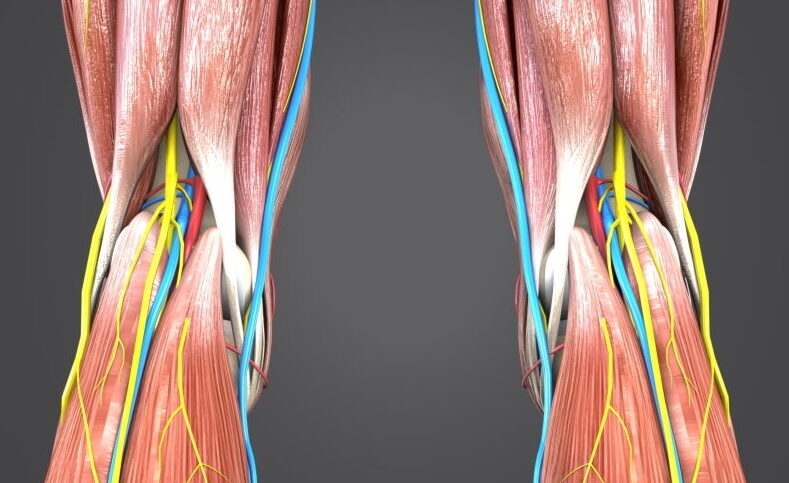
Pain behind the knee is one of the more challenging musculoskeletal problems. The causes are many — muscle tears, tendon injuries, nerve damage, and even blood clots. As with most problems, the key is an early, accurate diagnosis. So what causes pain behind the knee, and how do you find the cause?
This is the hub for pain at the back of the knee. For pain on the inside of the knee, see inner knee pain.
What’s behind the knee?
The back of the knee has complex anatomy. The knee joint sits in the middle, with the thigh and calf muscles passing through. The large hamstring muscles run from the pelvis across the knee to the lower leg bones, and the calf muscles begin at the bottom of the thigh and cross the knee to form the Achilles tendon. Vital nerves and blood vessels also pass behind the knee to supply the lower leg and foot.
How do we find the cause of pain behind the knee?
We use a methodical process. First, a thorough assessment of the joints, ligaments, and tendons that cross the back of the knee. We then use imaging to confirm our reasoning — X-rays pick up significant arthritis, and MRI detects soft-tissue problems such as tendonitis or muscle tears. Occasionally we add blood tests, ultrasound, or nerve studies, depending on the presentation.
Back-of-knee pain location chart
Use the chart below to find possible causes by location, and follow the links to learn more about each.
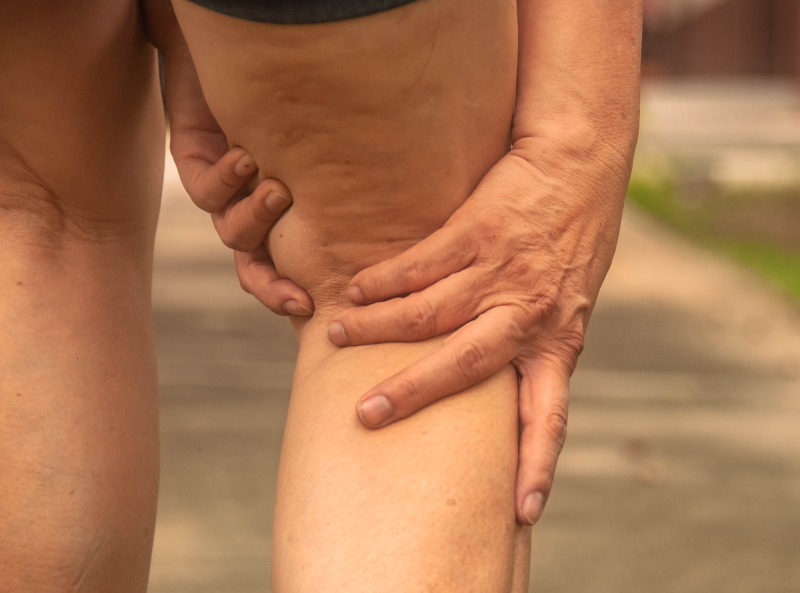
Inside back of knee
Top of the calf
Deep venous thrombosis
Outside back of the knee
Central back of the knee
Common causes of pain behind the knee
Knee arthritis
Osteoarthritis causes bone spurs and inflammation at the back of the knee, often with tightness and restricted movement. Exercise and load management are the best treatments, and a knee sleeve can help. Occasionally we use cortisone or PRP injections.
Meniscal tears
Meniscal tears cause pain behind the knee, usually more to the inside or outside. Most are degenerative. Sometimes the meniscus ‘root’ tears, where it attaches to the middle of the knee — then the meniscus stops working as a shock absorber, increasing stress on the joint. Treatment of degenerative tears is mostly conservative, except in younger patients after trauma, root tears, and knees that lock or give way.
Baker’s cyst
A Baker’s cyst is a fluid collection at the back of the knee, arising from the joint — so joint swelling makes the cyst bigger. Bigger cysts press on the joint, muscles, and nerves, causing pain. Ultrasound confirms it, and painful cysts can be drained under ultrasound.
Tendon and muscle injuries
Tendon injuries are common in runners. The tendons most affected are the hamstring on the inside (semimembranosus) or outside (biceps femoris). Rarely, the small popliteus tendon swells. Hamstring muscle tears occur about 5 cm above the knee — locating the tear matters, as it sets the return-to-sport time. A pulled calf or soleus tear near the knee can also cause pain here.
Nerve damage
Pinched nerves in the lower back (sciatica) or buttock (piriformis syndrome) can radiate down the leg into the back of the knee. But pain isolated to the back of the knee isn’t usually from nerve damage.
DVT (deep venous thrombosis)
DVT rarely causes pain only at the back of the knee — usually it extends to the calf and inner thigh, often with a swollen ankle and calf. The risk is higher with obesity, cancer, recent surgery, or long-haul travel. A hot, swollen, painful calf needs urgent medical assessment.
Frequently asked questions about pain behind the knee
Why is the back of my knee swollen?
Most often a Baker’s cyst, though these aren’t usually painful. See your doctor for severe pain and swelling — other causes include DVT or, rarely, a popliteal aneurysm.
What causes pain behind the knee and in the calf?
Pain spanning the knee and calf often points away from the knee joint — possible causes include nerve pain from the lumbar spine, piriformis syndrome, a calf or soleus tear, or a DVT. A hot, swollen calf needs urgent review.
What causes pain at the back of the leg behind the calf?
Pain behind the calf is often muscular — a calf strain or soleus tear — but can also be the Achilles higher up, or referred pain from the spine. If it comes with calf swelling and warmth, a DVT must be excluded first.
My knee MRI was normal — what does that mean?
A normal MRI doesn’t rule out every problem. We’d then consider causes outside the joint, such as DVT or referred pain from the spine.
When should I worry about pain behind the knee?
Seek urgent help if the calf is hot, swollen, and tender (possible DVT), or if you have severe pain after trauma, a locked knee, or the knee giving way. Persistent pain beyond a few weeks should be assessed.
Final word from Sport Doctor London about pain behind the knee
Pain behind the knee isn’t straightforward. Some causes, such as a DVT, can be serious; others need further investigation and treatment. See a sports medicine specialist for an accurate diagnosis and management plan.
To book a knee assessment with Dr Masci in London, contact the team here or call +44 (0) 203 488 0350.
My husband and I walk two miles a day. About every fifteen minutes I have to stop because the pain in thigh and shin is so bad. If I lift my foot up to my thigh it seems to release something and it is like I never had pain, but it only lasts fifteen to twenty minutes
Hi Nancy, exercise-related pain could be due to trapping of nerves from your spine or blockage of blood vessels to your legs. i suggest you see a doctor to get a proper diagnosis.
Hi
Can u help with Behind the knee pain is a bit high and outer edge with a small nodule between the two muscles attachments pretty deep. Not a baker cyst… too small( I think) relieved with massage.
Pain worse after extension from a prolonged flexed position . Can’t walk for a few minutes after?
hi Tracey, you could have small ganglion – these arise from joints or tendon sheaths. The best way to find out is to do an ultrasound scan. LM
https://sportdoctorlondon.com/aspiration-of-ganglion-cyst/
Hi I am suffering with bad aching pain I back of my knee I get pain on side on my knee I get shooting pains I carnt walk to far I get pain in my groune
Hi Susan, you could have a problem with the meniscus or knee joint especially if you’re having problems with the side as well.
https://sportdoctorlondon.com/torn-meniscus-in-knee/
I had a 100lb dog run full force into the front of my knee pushing it to over extend. I am able to walk on it just not to long or it will start hurting again. The problem is when I squat or bend the knee more than 90 degrees it feels like someone hits me in the back of the knee with a sledge hammer and the pain radiates down my calf to my toes. Is this concerning or will it be fine after resting a while more.
hi, a few possibilities
1) you’ve stretched the capsule at the back of the knee joint
2) you’ve damaged the cartilage and bruised the bone
3) you’ve damaged the ligaments in your knee
I’d see doctor to get a more specific diagnosis if your knee doesn’t settle within 2 weeks of the injury
Lorenzo
Hi
I have a Baker’s cyst but also with constant pain behind left knee on the distal (outside) that hurts more with knee flexion. No initiating trauma except it started right after pulling leg up out of deep snow.
Hi Eric, you might have pain from a degenerative lateral meniscal tear – Baker’s cysts often do not produce pain on the outside.
https://sportdoctorlondon.com/torn-meniscus-in-knee/
Hi, two weeks ago I was trying to play football with my sons and their friends. I tried to make a cut to the left and immediately my right knee was in pain. It has been sore ever since and I limp most of the time since then; it doesn’t seem to be getting better. I’m 48 years old but have kept myself in good physical condition mostly through weightlifting and good nutrition. I think the pain is mostly from the back of my right knee. There seems to be a crunching sound if I try doing a squat. Any thoughts? Thank you.
Hi Neal, You might have sustained a cartilage (meniscal) tear in your knee. Meniscal tears can present with pain at the back of the knee.
https://sportdoctorlondon.com/torn-meniscus-in-knee/
Hello..Happy New Year…had total knee late August..model patient..when I finished therapy last month..developed crippling pain I’ve both legs..behind knees..esp knee that wasn’t operated on..after 2 weeks my pain mgmt doc prescribed methoprednisone pack..did not help..I can stand no problem…stairs are terrible..up and down..I am wearing compression hose..help a little..taking hydrocortisone acetaminophen 2 x day..naproxen..gabopenten twice..Tylenol pm to sleep..starting new PCP on 19th…what can I do in meantime..I would greatly appreciate any advice..ty
Hi Susan, sorry to hear about your problems. I assume you’ve had a scan for your (non-operated) knee. It’s hard to advise without knowing the cause. LM
Hi. After sitting for an extended period, and I stand up, I have a bad pain just above the back of my knee. It’s in a targeted area. After I take several steps, it goes away until the next time I sit and then stand. The longer I sit, the worse the pain will be when I stand. I had foot reconstruction surgery (flat foot) in October on that leg, and this pain started when I was finally able to put my foot down 3 months later. Right up to that surgery I had been going to PT for a dislocated kneecap. There is also dull aching in my lower buttocks.
hi Colleen, you could have a degenerative meniscal tear in your knee. The other possibility is referred pain from the back. I’d suggest you see a doctor to get a proper diagnosis.
Lorenzo
Hi Lorenzo,
Thanks for your blog, it is very informative for knee pain and It’s useful for my mother in law knee problems. But you want to add how many days to take this recovery this pain!
Could I share this post?
Hi there!
I am a ballet teacher last week while teaching I had a sharp pain run down through my knee to my calves. Since then my knee has been very swollen behind the knee and very very painful I can’t straighten my knee completely and when I bend it , it is extremely tight can you help me? What could this be I went to the doctor got x-rays they showed nothing. They had no diagnosis for me. It’s Kaiser 😵💫.
hi you could have developed a degenerative meniscal tear leading to pain at the back of the knee: please read my blog
https://sportdoctorlondon.com/torn-meniscus-in-knee/
Hi, in 2019, after walking for several hours around London, the back of my left knee became very painful. Thinking I had strained something I assumed that it would over time get easier. However by the time I realised that it was getting no better, the Pandemic lockdown was imposed so I was unable to get to see a doctor. The problem still persists and every evening there appears to be a lot of fluid around the joint.
hi, you could have a baker’s cyst or a meniscal cyst (or both).
https://sportdoctorlondon.com/bakers-cyst-on-ultrasound/
https://sportdoctorlondon.com/lump-on-the-side-of-knee/
I hope that helps. Lorenzo
Hey there!
I was playing softball and I was running hard to 1st base, I felt the tendon behind my knee on the right side pop. I could barely walk for a few days. I have been slowly getting back into physical activities and was playing basketball the other night “this is 4 months after softball” i still can’t make my cuts because that tendon gets tight and feels like it’s going to pop again. What are some stretches I can do and what causes this to happen? It also was bruised the first time. I didn’t go to the dr.
hi Cody, the popping is a little more of a concern to me. You could have injured your knee joint – cartilage or ligaments. I think it’s time you see a doctor. Lorenzo
It’s been almost two years since whatever happened to the back of my knee, happened. Ive been a runner for a long time but this time particularly my knee swelled. I thought I had over done it so I laid off. A couple weeks later after the initial swelling episode, I was doing sit ups for time, and when i got up i felt the back of my knee “pull” and since then but not all the time it will flare up and i don’t necessarily have pain but it “pulls” and i cant open my leg all the way. It is uncomfortable, but not painful. Is this inflammation or something more? I’ve had an MRI and was told i have some arthritis but nothing else. Could it be a hamstring injury. i’m 41 yrs. old. Any incite would be appreciated.
Hi Rebecca, I think your pain is related to your arthritis and knee joint swelling. I don’t think your description fits. hamstring injury. Lorenzo
I’ve worked on my knees for years wearing knee pads I have got cartilidge problems ache side and back of knee I’m in my seventies and still working on roofs flat do knee pads straps strangle your joints she working struggle getting up and down which goes with job. Tony
Hi…I have pain in back of my left knee. It occurs when I go into a deep squat coming out of the whole. I have a sharp pain and I have to grab on to something to get back up. Pain is very local and nothing radiating up or down. It only occurs when I squat.
Hi Ramsin, I suspect you have an issue with the cartilage in your knee. see this blog on meniscal tears:
https://sportdoctorlondon.com/torn-meniscus-in-knee/
Often, tears in the posterior horn of the meniscus can cause pain at the back of the knee.
Regards
Lorenzo
Hi there,
About 5 days ago I was in the dog park and slammed by a pack of running dogs below my left knee. My shin went backwards with the impack and I fell forwards- I caught myself on the way down with my right leg. The first few days I could put very little weight on it. Now I can walk ok (some tinges of pain if I twist) but bending (stairs/ knee flexion hurts) also if I don’t walk a lot/ sit for a long period of time in a day I start limping again due to pain. Not sure i should go to a doc or if it will just get better with time? Thoughts?
Ho Jenna, You might have bruised or torn the cartilage in your knee. I suggest anti-inflammatory measures – ibuprofen and ice. If it doesn’t settle with these simple measures, then I suggest you see your doctor.
https://sportdoctorlondon.com/torn-meniscus-in-knee/
Lorenzo
The pain is on the back inner side of my knee.
I have bakers cysts that have not been painful. What procedure can get rid of them?
hi noel, So as a general rule, I suggest you leave the Baker’s cyst alone unless 1) you don’t like the cosmetic appearance or 2) it becomes painful.
If you want to get rid of a Baker’s cyst, I suggest a trial aspiration.
Lorenzo
Hi, I have pain in the back of my right knee when I sit on my heels. Does not hurt at any other time?
I am 75, a very active, lifelong cyclist and I had triple bypass surgery exactly two years ago. (100% recovered, but I am on a statin) Four days ago I began to have a severe pain behind my knee. It is in the very center of my knee/leg – just slightly below the hollow of my knee but I do not think it is the calf muscle. It is a severe pain when I first get up in the morning or if i sit for a while. It loosens up when I walk or bike but the pain is still there. I have used Voltaren cream on it the past two+ days but that does not seem to help. This morning, the same pain, less severe so far, began in my other leg. I have read your (and other) explanations of sources for back of knee pain and none seem to match my situation. Wondering if it could relate to the statin, or if you have other suggestions?
Hi Ted, Generally, pain occurring in both knees increases the likelihood of referred pain from above – usually the lumbar spine. I’d see your doctor if the pain doesn’t settle. Lorenzo
I have excruciating pain behind my knee when I am walking. It hurts more going up the stairs than down the stairs. It is very painful bending my knee back towards my buttock. . I had a a scan and it is not a bakers cyst. Do you have any ideas what this could be from?
Hi it could be related to a problem in the joint (cartilage/meniscus). You should see your doctor.
Lorenzo
Wonderful article..Thank-you . Last night I twisted in sleep and awoke with sharp pain to knee. I could not bend it and felt afraid to straighten it. The inner area just below my knee cap had a “crispy, crinkly cord” under the skin and after I massaged it for a moment it disappeared but all day my knee feels loose and I need to walk carefully to prevent instability and quick jabs of pain. Can you tell me what the odd crinkly cord was and why it disappeared when I rubbed it? My knee did bend afterwards. Can I let this “injury” heal up on its own or do I need help?
Thank-you so much.
Denise
Hi Denise, it’s hard to know what it could be without seeing your knee and examining it. I’d suggest you see your doctor if your knee doesn’t settle. It could be inflammation of the tendons on the inside of your knee https://sportdoctorlondon.com/pes-anserine-bursitis/ or a cartilage injury. Lorenzo
Having pain in the back of the left knee, it feels full but no swelling. Hard to stretch my leg. No bump. Doesn’t hurt when I rub or massage.
Hi it could be a baker’s cyst (even though you can’t feel a lump). I’d suggest you see someone if it doesn’t settle.
Lorenzo
Your article was very informative. But I can’t decide which is my cause. For 3 weeks I haven’t been able to put weight on my right leg. Back of the knee is extremely painful. I put a brace on it because this did thiss a year ago. Going down a slope or stairs just kills me. Been to chiropractor for 3 weeks he keeps telling me it is sciatica. I feel like I’m getting no where. Last year I was given 2 injections before I felt relief. Stick with chiropractic or suck it up and go to a Doctor?
I think it needs further investigation. I’d see a doctor.
Hi. I have a knot on the inside part of my knee. The pain is a burning pain until I get up to walk. When Walking there is pain in my upper calf and pain that goes up into my inner thigh. Sometimes the knee feels like it bends backward some. When this happens I have to stop walking for the pain to ease. I work at a desk all day and am quite obese (morbidly). Could this be muscle related, nerve or DVT? I also have arthritis in that knee and h/o knee and ankle tendon tears back in 2009.
Hi Michelle, I suspect it’s related to your knee joint. However, you’ll need to see a doctor to confirm.
hi i’m 39 years old and I get pain in the back of my left knee after a few minutes of walking but when I stretch out my knee as far as it can go and hold it there for a few minutes the pain eventually goes away now i don’t ride a bike or do a lot of sports that require a lot of running and this problem happen only a few days ago from writing this i’m thinking of getting a knee pad joint support will that help me anyway if you can tell me what you think is going on with my knee and how to fix it i would be extremely grateful
Hi Jamie, If your pain settles with a calf stretch, then it might be muscle tightness rather than other more serious pathology.
I’d try to stretch before walking or activity.
I’d see a doctor if it doesn’t settle.
Lorenzo
Hard to straighten my leg and tightness behind the knee in the morning, also generally soreness back of knee
Over three years now my knee has got really bad it’s in the back off the in pain all time doctor gives me all sorts of medication but no good I’ve got a job to walk now the pain is terrible if I Straighten my legg it kills
Hi Nigel, I suspect you have a problem with your knee joint. I’d see a doctor to get it investigated.
LM
Hi, I had a hip replacement 14 years ago with no troubles at all. Now I have episodes of pain behind my knee in same leg, which can last for a week to 10 days or longer. It hurts when I get up and put weight on it, but hurts much more when I try to lift my leg to take a step. I hobble to the toilet and back, sit down and brace myself as it hurts more and radiates down shin to my outer ankle. It takes about a half hour for it to settle and stop hurting. Then I’m comfortable until I need to get up again. I’m 63 yr old. My Dr just said it’s arthritis without even examining me. Do you think it’s just knee arthritis or could it be related to my hip replacement? (I sure hope not but do wonder).
Thanks
Hi Lesley, It could be knee arthritis. I’d suggest you get imaging – X-ray to begin. Lorenzo
My husband was walk8 g down the steps outside n when he got to the bottom his knee gave out n now he has severe pain behind the knee n it’s swollen n red n feverish what can we do to lessen the pain
I suggest ice and anti-inflammatories such as ibuprofen.
https://sportdoctorlondon.com/how-long-does-it-take-for-ibuprofen-to-work/
You should see a doctor if it doesn’t settle quickly.
Hello I am 66 yrs old and am experiencing extreme pain mostly behind my knee with some radiating above and down into my calf. I also have pain along the inside of my lower leg with some in the front. I visited an ortho Dr and X-rays showed nothing am currently waiting for appt to have MRI trying to bear weight is almost impossible. Should I try to keep bending my leg even though very painful? Also should I wear an ace bandage?? The Dr did
Give me a shot that contained novacain(so) but with little reduction in pain. Thanks for listening!!
Yes I’d continue with range of motion exercises and a brace.
I have an intense pain in the back of the knee and to the outside. It gets worse with stair climbing, over extension & general increased activity. I’ve had an X-ray & MRI and nothing specific has been detected ( fat pad impingement & a little joint degeneration). Could a meniscus tear be missed on a scan & if so how can I get it diagnosed?
Hi yes MRI can miss subtle tears of cartilage. Pain can also arise from degeneration. A cortisone injection into the knee joint can be diagnostic and also therapeutic.
LM
Helo. Im a 46 year old lady. The last 3 months of 2021 i was busy with exams and most of the time i would sit and when i feel tired i stretched my right leg and placed it on to another chair. Around January 2022 i started experiencing pain especially at the back of my right knee and behind my thighs. The pain is still persistant now but there is no swelling nor loss of balance. sometimes it disturbs my sleep. could it be arthritis.
Hi, If you’re developing pain at the back of the thighs, then you might have pain coming from your spine or hip. You need to see a doctor who can examine you and refer you for imaging if clinically indicated.
LM
HI, I am an 82 year old man 6’- 1” tall. I have had pain on the back side of my right knee and down part of my calf for over a month. The pain goes away when I am in bed or sitting. When I get out of bed in the morning it will usually click. I cannot stand on my leg for more than a few minutes. Sometimes it gives way suddenly when I am walking. I have to rely on my left lag when getting up out of a chair.
I am on a blood thinner so I can’t take ibuprofen. I have seen my primary care Dr. He ordered an x-ray. The impression was of degenerative changes. No acute abnormality. I also had an ultrasound to check for DVT. They found a small Bakers cyst. I have had a Physical Therapist check me over and she was stumped. I think what I need is an MRI but this would have to come from an Orthopedic Dr. In this medical desert where I live I can’t get an appointment to even see the Physicians Assistant for sometime in May. Any help would be appreciated. .
Yes I think an MRI would be appropriate. But I’d speak to your doctor.
Lorenzo
I have, I thing, pulled a muscle at the back of my knee. its above the calf and just behind the right knee. probable from hamstring curls or toe raises, very painful. How do I fix it?
If it’s a pulled muscle, then it should respond to exercises for the hamstring such as hamstring curls and bridges.
Hi,
I have pain behind the knee that happens intermittently. Usually it lasts in 1-3 seconds sometimes 30 seconds. It is quick but painful. I walked a lot but also have 6hours in average time in sitting position due to work. The pain I believe is somewhere inside behind the knee., not swollen, no redness, just quick pain and I dont know why it happens…
Hi I think you need further imaging – it could be intra-articular – X-ray and MRI.
Lorenzo
Hi did you find a cure to your pain? I am having the same symptoms. Please help. Thanks.
Good morning, A week ago I was walking and felt a dull pop feeling in my right knee followed by a dull slow moving pain down to my foot my toes got tingly and then went numb. I took my boots off and socks my foot all white and no feeling in my toes. Everything went back to normal in just a few minutes. Walked around again and my right calf started getting really tight, to wear I could not even walk on it. The pain in my knee comes from the back and center of my knee. I have tried stretching in and ice and hot packs makes nor difference. I can only walk a round 10-15 minutes
Hi Robert, Your problem sounds intra-articular. Perhaps a cartilage tear with a Baker’s cyst. You should see a doctor.
Should an mri or cast scan be down to find out why my knee has been like this for 3.5 year. For they don’t know what going on. The pain is ecruseating.
MRI scan is better.
LM
Hi, I slipped over in the bathroom about 2 years ago, and my full body landed on my bent knee. At the time it was a little sore, but I was up and about as normal within a few days. Since then though I have found it difficult to crouch or kneel and when |I attempt to get up I need support/help. I am a keen walker and usually do about 3-4 hours walking in the countryside, but have done very little since covid. It has only been the last month that I am walking/rambling again but now I can only do about 1 hour of slow walking before pain at the back and side starts. I also experience weakness of the knee making walking really difficult. The strange thing is that if I take a short rest of about 10 – 15 minutes just sitting on a bench or chair, it seems to recover and I can almost walk normally again, that is for about another 40 minutes.
There is no obvious swelling or redness. I am 66 and do not want to stop my countryside walking exercise, any thoughts?
Hi it could be the knee joint or referred pain from your back. You need to see a doctor to help with a diagnosis.
Hi
I am 43 and over the last year I started experiencing pain at the back but not inside my knee when I did deep squats. The pain would then go away and would sometimes trigger again. Over the last couple of weeks I haven’t been able to exercise as much and it’s started hurting more and feeling tight even without any exercise. There is a tiny bit of swelling but no lump.
Hi Kate, It could be a cartilage tear. I’d suggest you see a doctor for further investigations.
Hi, I am 77 years of age and had an inner partial knee replacement approx 1 year ago. I don’t seem to have much problem with the inner replaced knee, just an odd twinge.
I have suffered with IT Band problems for most of the last year but my problem now is outer knee swelling and pain, also burning pain at the side and back of my knee and muscle pain in the thigh. I’ve taken 3 weeks of naproxen to get the swelling down and if I stay indoors I’m fine but as soon as I go outside to walk the problems start. Any advice.
You’ve probably developed degenerative problems in the lateral (outer) compartment. I’d speak to your doctor – perhaps an up-to-date X-ray is needed.
Hi I’m a 50 year old woman , I started rugby training a few months back , not played yet so no contact .
During warm up a few weeks ago the back of my knee started hurting every time I put weight on my leg it eventually eased off after a week of rest ice and elevation the following week at training it was fine no pain also fine in the gym but the following week again at training again it started again (only slight running & quick walking ) again eased off with rest , then walking the dog as I do every night it started again , I just about made it back home .
I have a support bandage on at the moment but the pain is unbearable and throbbing , the front of my knee also throbs when lay on my front in bed . I regularly take naproxen for tennis elbow and shoulder pain as well as amytriptyline neither are helping with this pain .
You should see your doctor. I suspect you have a problem with the joint – probably cartilage related problem.
https://sportdoctorlondon.com/torn-meniscus-in-knee/
Good Afternoon –
About four weeks ago while traveling I was going to breakfast at our hotel, on the way I felt some tightness behind my left knee and calf. After breakfast we headed down two short (6 to 8) flights of stairs. At the bottom of the second flight I was unable to put any weight on it and it became swollen. I was unable to fully extend while walking and was unable to put full weight on it for the next several days. After returning home it was xrayed it shoed some k1 & k2 arthritis and some small bone spurs that were deemed unlikely to be the cause. A week ago I got a cortisone shot felt great after a day and went back to walking 30 to 40 minutes per day as was routine prior. After three days of resumed activity I was back to being unable to fully extend my knee and have a pulling sensation behind my knee, no real pain but do not feel as though It will support my full weight. The swelling has not returned but I am back to limping around with limited mobility.
i’d suggest further imaging if your pain persists – MRI scan.
I walked 3 miles today and started to experience pain in my left hip, then pain behind my left knee. Could it be hip related?
potentially yes – hip problems can radiate into the knee. You should see an MSK doctor to confirm.
Hi, I have pain behind my knee when I bend it, lying in bed & moving & getting up off the ground. I had a minor fall playing netball 2 weeks before the pain started but the main cause or when I first noticed the pain was after sitting down with my son (who had just broken his nose) on the ground for over an hour (waiting for abulance), firstly was sitting with knees bent in an awkward position then had them straight out. Since then the pain has been constant but not noticeable when playing netball or football (hooray). Any ideas what it could be? Do I need to get it checked out? I can’t rest it & will be playing my sport for a few more months. Am 39, no previous injury to me knee. Thank you :)
Hi Eleina,
I suspect you’ve developed minor irritation in the back of your knee joint. I’d see a sports medicine doctor if your symptoms don’t settle by the end of this month. LM
Hi
i too have a pain behind my right knee also swollen. However the pain that wakes me is
on the outside of this leg below the knee. No blood clots found ….the pain throbs and effects
my big and second toe, it feels like a pulling or tingling pain. Had it for around eight months
meds and cream etc help but no nearer to getting a diagnosis ??
I’d see a specialist doctor to get a specific diagnosis. You might have nerve pain arising from the knee or the low back. Lorenzo
I fractured my ankle 2 weeks ago. (Non surgical) Was in a hard cast the first week and now a boot. I was in the boot for 1 week no weight bearing and this past Friday started weight bearing with crutches… yesterday the back of my knee started hurting. Not excruciating, but sore and tender to the touch. No redness or swelling and wasn’t sure why.
Hi Milly, It’s probably muscle tightness related to being in an uncomfortable cast. I’d seek medical attention if it doesn’t settle after a week. If you develop swelling, I’d make it a priority to seek medical attention.
LM
Hi my knee popped and locked and couldn’t put any weight on it while I was carrying hoover down the stairs about 6 weeks ago I’ve recently been to see specialist as had a lot of pain in my knee I can’t kneel or keep my knee in a bent position if lying down since I’ve been to see him the pain in my upper calf is really painful and seems I’m back at stage one when the accident happened I’ve just brought a new knee brace as the one hospital gave me is useless what could the secondary pain in my top calf be as it’s really quite painful and leg feels rather stiff or tight when walking
It could be referred pain from knee pathology such as a meniscal tear.
Hi, I twisted my right knee almost 2 months ago. The Xray and Ultrasound showed Osteoarthritis . The MRI showed meniscal root tear and medial Collateral ligament tear. I am 49 years old woman. The ortho surgeon told me not to worry about the tears a they are there because of the advance age f arthriti and that i need to get knee replacement done in 5 year.
the physiotherapist told me to manage the pain and condition by doing therapies as there is a crack in the right knee cartilage and no need of any surgery. He said the cartilage is still there and not fully gone which is opposite to what the surgeon has said.
There is still swelling on the inside part of my knee. The pain is there and I feel scared to walk as it gets very uncomfortable and the knee gets unstable. The back of my knee and the ide and a bit of the face of the knee hurts.
Hi, I was using a resistance band above both knees, stepping to the sides (in order to work out outer hips). I have had knee pain and stiffness since then (almost 2 weeks ago) in the right knee. I have iced it and even had a massage…pain is in the back and sides. I had this happen one other time when doing the same exercise. It healed/went away in about a week. Do you think I need to see a Dr. or just continue with ice and rest?
Hi Karin
I’d continue with ice and relative rest for a bit longer
LM
I was doing Yoga in the summer and suddenly ( afterward) I found that I had pain behind in my right knee cap deep inside if I squatted or bent my leg more than 90 degrees. It went away after a while as I stopped doing yoga. I started my yoga again and lo and behold the pain in back. It appears now to have a tingling sensation down to my toes and there is a bit of twinge on the back right tendon when I bend the knee or ‘transition ‘ from a straight leg to a bent leg. No pain upon standing or weight bearing. I want to go to the local Dr but would appreciate some insight first. I kind of feel like maybe I twisted something or something is out of place. No constant pain. only in transitioning. Any thoughts would be appreciated.
You need to get the knee checked bu your doctorto see if you have a cyst – either Baker’s cyst or menciscl cyst compfressiong a nerve at the back of the knee. Alternatively, your pain could be coming from your lower spine.
Hi, Last week I started experiencing a sensation in the inside back of my knee after walking up the stairs or keeling, i’d feel a tightness that would then release when straightening the leg, almost like a ligament had moved out of position, sometimes the tension won’t release by itself but I can physically move something on the back of the knee that then relieves the tension, it’s not painful just an uncomfortable sensation. I’m a 49 year old regular cyclist.
What do you think this could be? And who should I see to remedy the issue, is it an osteopath or a physio?
Thanks,
David
Hi David, Most low-level pain/sensation will settle with time. if it doesn’t, I suggest seeing a physiotherapist or sports medicine consultant to confirm a diagnosis.
LM
I have been dealing with severe pain behind my knee now for two months I closer to the tendon on the outside of my knee. So bad after standing for 30 mins to an hour I can barely bend my knee to sit after. I am almost chair bound. I have gone the R-I-C-E route all to no avail. I tried a shot of cortisone it worked for two weeks only went back had second shot same result.
Just went and had. Monovisc injection done no relief after a week so far. Really frustrated because I have done nothing to injure it at all.
Hi Barry, sorry to hear about your ongoing pain. I presume you’ve had imaging of your knee. I’d speak to your doctor about other options. Cases like yours can be frustrating and tricky. All the best
LM
Hi Dr Masci.
I’m suffering from pain behind the knee. Specifically, top of calves, behind both knees and slightly more on the inside than out. Thanks for your overview article – highlights how complex it can be to diagnose and treat. Any advice appreciated. Here are my details:
Initial onset: 2-3 months ago.
How: self assessed likely cause is straight/stiff legged deadlifts done during a HIIT/crossfit class. First time doing. Heavy weight. Severe DOMS, then residual pain behind the knee as described above.
Progress: initially eased of HIIT/crossfit strength&conditioning which helped relieve pain. But kept boxing training. After knee pain subsided, resumed S&C training, pain returned but intensity varied and pain behind knees came and went. Last few weeks, getting worse.
Other injuries possibly confounding or related:
– small meniscus tear on one knee confirmed by MRI at least one year ago before behind the knee pain in both knees. Another injury caused by first time HIIT/crossfit exercise specifically Turkish get-ups (weighted). Probably unrelated as behind the knee pain is in both knees not just one knee.
– lower back pain. Long time (years) issues, comes and goes, currently hurts, is most likely due to intense ab exercises done weekly in boxing training (various leg raises including rotations). Probably unrelated as has been gone while behind the knee pain remains.
– hip flexibility. Not very good, thoracic rotations are fairly poor.
I’m reasonably sure my behind the knee pain is caused by the straight legged deadlifts. Never did them again. https://www.advancedhumanperformance.com/the-worst-way-to-perform-deadlifts-and-rdls
I think it’s tendonitis. Hamstring or Gastrocnemius. Not very confident of that. What do you think it could be?
Thanks, Paul.
Hi Paul, it could be low hamstring tendonitis, given your description. Obviously, the caveat is that you need to see a doctor to confirm.
https://sportdoctorlondon.com/low-hamstring-tendonitis/
Regards
Lorenzo
Thanks Dr Masci – agree it’s time to see a doctor!
Hello 40 year old female here. A few months ago I had a fall and landed on my left knee. Everything seemed to heal until most recently I seem to have knee pain behind my knee to about top of calf muscle. Occasional throbbing in front of knee as well when lying down. Behind knee pain almost feels like pulled muscle but isn’t getting better at all. I exercise regularly lots of treadmill running and fast paced walking mostly now since pain. Also dance, light dumbbell weight routines and occasional hiit workouts. Have tried knee braces and sleeves but seem to put pressure that makes it more uncomfortable. Any idea what may be the problem or any ways to get me back to comfortably running on treadmill etc.?
Hi, You may have injured your knee cartilage/meniscus. I suggest you see a musculoskeletal doctor to assess your knee.
LM
Very informative for the lay person. My left knee has pain in the back, when I sleep the back of my knee contracts a muscle, yet to be identified, and it is hard to straighten, the pain level is 10+. My left leg does not bear my weight thus the stairs is very difficult, descending harder than ascending, but I usually end up in a crawl. The answer is its my knee degenerative condition. I do have arthritis and get monovisc injections. I am a 73 wf, whose somewhat active life has been interfered with. I do not have a regular walk schedule although I do tai chi. I cannot run or jump anymore yet I do shoot hoops occasionally and walk to retrieve the ball. I can throw a football, bat and pitch a ball, but running is no longer an option in these games, what can I do to improve my mobility and relive my leg pain. I live in the U.S.A.
Hi Elizabeth, you might have a problem with your knee joint – cartilage damage or arthritis. You should see an experienced musculoskeletal doctor who can help with making a diagnosis.
LM
Hi there. I’m a fit 6o year old male. I’m a keen runner and until a few months ago, I was running over 40 miles per week. Last October, I was schedules to run a marathon. I’d done 6 training runs of > 22 miles in the 6 weeks prior. I just started to get a minor ache behind my left knee, which tended to ease away after a mile of so of running. Over the lest few months, this pain worsened, which has severerly curtailed my running. Sometimes it hurts too much when running, and most of the time there is a dull ache, which sometimes stretched down to the top of my calf. However, occasionally, I can run relatively pain free. Been to a physio and he ruled out damage to knee ligaments. Often hurts when lying in bed, especially when I stretch out my leg. Very frustrating ! Any ideas?
I suspect your problem arises from the knee joint – cartilage damage or meniscal tear. I suggest you see your doctor.
LM
Hi, I’m glad I found this article. I have pain behind my right knee, right in the middle when I squat and also when I extend my leg and stretch the back of my knee. It started around 4 weeks ago and hasn’t stopped. I’m starting to feel it on the inner part of my knee as well. A little backstory, I had a nerve conduction study and it revealed I have a pinched nerve at L7. I also had surgery on my C3-C6 a year ago and had saddle embolisms in my lungs with the clot busting surgery. I have degenerative disk at C7. I’m worried. I have a doc appointment on the 6th.
Correction- the pinched nerve is at L4
It could still be local pathology in the knee joint – you need to see your doctor.
LM
I’ve been trying to get help with my right leg since 2019. I was warming up for a run one day (Army) and I pulled my hamstring really bad; I stretched and tried to run anyway which made me pull my calf. I took a few months off resting, treating and recovering only to pull the hamstring again doing back extensions in the gym. Once again rest, treat and recover. Ever since that day, no matter how much I stretch, take time off, warm up, or whatever, I continue to get a pulled calf muscle when I run; if I don’t pull it on the first attempt, it is guaranteed to pull on the second run. Of note, I played football and ran track all through high school and then joined the Army and ran (very well) without issue up until this point (17 years). Now, I can’t run at all. It feels good to run, but my calf muscle will pull every time, no matter what. Also of note, that right leg is so tight in the achilles and behind the knee, and my calf and hamstring always feel overused.
You might be experiencing repeated soleus muscle tears – see this blog: https://sportdoctorlondon.com/soleus-muscle-strain/
LM
Hello Lorenzo.
I have a discomfort on the back of my left knee sort of on the left side. And a feeling of my knee hyper extending unexpectedly when walking.
It’s now been going on for a week.
Before I noticed this the first time, I’ve been very active.
Been snowboarding 3 days in a row and rollerblading 2 days after that. All over a period of 7 days
Although no falls or twits to the knees.
Hi Martin, It could be anything. However, if you’d been active prior to onset, I’s suspect a tendon issue.
https://sportdoctorlondon.com/low-hamstring-tendonitis/
Hi, I was squatting down reading a putt in golf and when I got back up to my normal positioning I think this is where my injury occurred. I have no swelling and have full range of motion with no pain. The only time I have pain is when walking and usually happens when I release with my foot pushing off the ground. The pain is mostly in the back right of my knee but also seems to have some pain in the very upper calf near the knee. My knee also feels a bit stiff/tight. After I felt the injury I seemed to have a little line behind my knee that was parallel with the ground but also had a similar one that wasn’t red on my other knee so I disregarded. I’m a regular golfer and wanted to know my limitations since I have no pain when I swing and have full range of motion with no pain. The pain only occurs when walking. Disregard above comment I made earlier. Thanks!!
As a general rule, if you have no pain with a certain activity ie golf, I’d continue. But I’d still recommend you see a doctor for a full assessment.
LM
No previous history with this pain. I’m a woman, aged 53 and a runner. I was doing a long run yesterday and from about 17km onwards the leg behind my knee on the inside was hurting/feeling stiff with each step. i haven’t fallen or knocked it. I do have problems with achilles and tight calves on that side, so do a lot of calf raises. I’m assuming its tendon based again but would like to keep running so am icing to relieve it and resting today, what do you think it might be, and what strengthening exercises can i do to help? Thanks
Hi Jas, you could have developed lower hamstring tendonitis please see this blog:
https://sportdoctorlondon.com/low-hamstring-tendonitis/
Hamstring strengthening exercises will help.