
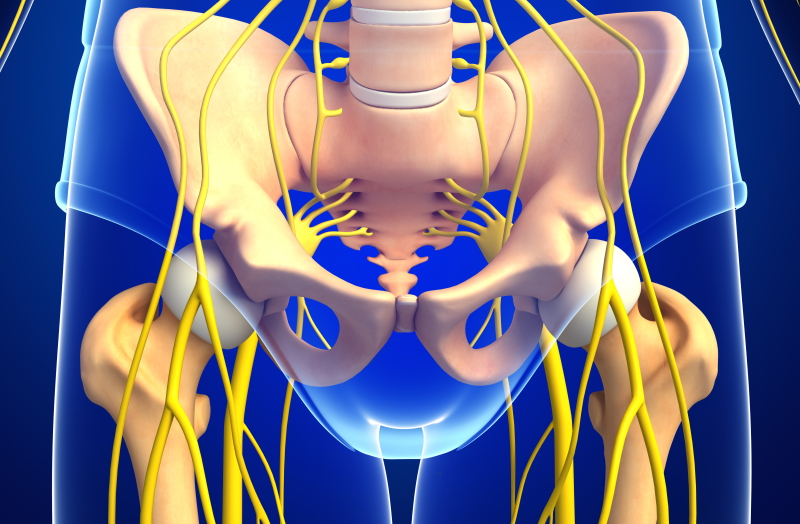
When people have pain in the lower abdomen where the leg meets the pelvis, we call it groin pain. It can spread backwards to the perineum or buttocks, or upwards to the abdominal muscles. Many conditions cause it — osteitis pubis, inguinal hernia, and hip joint problems. But sometimes the cause is a pinched nerve in the pelvis or groin. Groin nerve pain is hard to diagnose because imaging often looks normal. So how do we diagnose it, and what are the treatment options?
This is the overview of the nerves that cause groin pain. For nerve pain in the thigh itself, see nerve pain in the thigh and burning pain in the front of the thigh.
Common nerves causing groin pain

Symptoms depend on which nerve is affected. The common nerves that cause pelvic or groin pain are listed below.
Pudendal neuralgia
The pudendal nerve runs between the buttock muscles, close to the sacral bone, into the perineum — the part of the buttock that touches a bicycle seat. Trapping causes pain in the perineal area.
It’s usually caused by prolonged sitting, which presses on the nerve. It’s so common among cyclists that it’s called cyclist’s syndrome — if you’re a cyclist with perineal pain, get help adjusting your bike setup and seat.
People describe burning pain in the perineal or hamstring area. In men, it can radiate to the penis or scrotum; in women, to the vagina or vulva. Pain is usually worse when sitting and relieved almost instantly by standing, and it can occur with intercourse or bowel and bladder movements. It’s sometimes confused with hamstring tendonitis.
Obturator nerve pain
The obturator nerve forms in the lower spine and travels through the iliopsoas (hip flexor) muscle. It enters the inner thigh and groin through a hole in the pelvic bone — the obturator foramen — then divides into two branches, supplying the adductor muscles and inner-thigh skin.
Trapping causes inner-thigh pain, usually with running or sport, sometimes with numbness, tingling, or adductor weakness. True obturator entrapment is rare, but we commonly see obturator pain with twisting and changes in direction, often alongside pubic overload or osteitis pubis. Rarer causes include pelvic tumours, pelvic surgery, or inner-thigh trauma.
Ilioinguinal nerve pain
The ilioinguinal nerve comes from the lower spine. It crosses the abdominal muscles, travelling through the inguinal canal to supply the skin of the inner groin and the base of the penis or labia.
Hernia and abdominal surgery can pinch or damage it, and blunt trauma to the inguinal region can aggravate it. People experience sharp, throbbing, or burning pain in the inguinal area (inner groin), sometimes accompanied by numbness and tingling. Extending the lower back makes it worse. It’s easily confused with osteitis pubis.
Genitofemoral nerve pain
The genitofemoral nerve comes from the spine and runs through the iliopsoas muscle. It splits into the genital branch (supplying the vulva or scrotum) and the femoral branch (supplying the front of the thigh).
Damage or trapping can follow abdominal surgery, direct pelvic trauma, or pregnancy. People feel sharp, stabbing, or throbbing pain in the vulva or scrotum, between the legs, or in the front of the thigh. It’s often confused with other groin problems, such as iliopsoas tendonitis.
How to diagnose a pinched nerve causing groin pain
Groin nerve pain is difficult to diagnose because it overlaps with other groin and perineal conditions. If the standard investigations are normal, we should suspect a pinched nerve. Tapping the nerve at the trapping site often reproduces the pain.
We use several tests to confirm a diagnosis:
- Nerve conduction studies — to establish how and why entrapment has occurred (though sometimes normal)
- MRI scan — to look at the nerve and rule out other causes
- Blood tests — to exclude other causes of nerve dysfunction, such as diabetes, an underactive thyroid, or immune problems
- Ultrasound — to follow the nerve’s course
- A diagnostic nerve block — ultrasound-guided local anaesthetic; if it relieves the pain, a trapped nerve is more likely
It’s essential to exclude other causes of groin or pelvic pain, such as a pelvic growth, pubic overload, or nerve trapping from the spine.
Treatment of nerve pain in the groin
If a pinched groin nerve is likely, there are several options.
Medications
We recommend medications for neuropathic pain — antidepressants and anticonvulsants. Amitriptyline is an antidepressant that, at low doses, works well for nerve pain. Another option is duloxetine. They likely work by changing the pain receptors in the brain and spinal cord.
Procedures
- Injections of cortisone and local anaesthetic at the trapping site can reduce pain, usually guided by ultrasound; examples include pudendal, ilioinguinal, and obturator nerve blocks. Sometimes we use nerve hydrodissection with local anaesthetic and 5% glucose. Occasionally, nerves are treated with radiofrequency ablation, giving relief for months or years.
- Surgery to release the trapped nerve can help, but we suggest exhausting other options first.
Frequently asked questions about groin nerve pain
What does ilioinguinal nerve pain feel like?
Burning pain that starts at the lower abdominal wall and spreads to the inguinal region (the crease between the lower abdomen and upper thigh). It’s usually worse with hip or abdominal movements, such as abdominal twists or hip-flexor stretches.
How do we treat ilioinguinal nerve pain?
We start with nerve medications such as amitriptyline or duloxetine. Sometimes we perform an ultrasound-guided ilioinguinal nerve block, in which the nerve passes between the abdominal wall muscles. If the block relieves pain, we consider longer-lasting radiofrequency ablation.
Can the ilioinguinal nerve heal itself?
Yes. Though relatively uncommon, ilioinguinal nerve pain can settle on its own and may not need treatment.
What does nerve pain in the groin and inner thigh suggest?
Inner-thigh and groin nerve pain points most often to the obturator nerve, which supplies the adductors and inner-thigh skin. Pain with twisting or change of direction, sometimes with adductor weakness, is typical — and it often coexists with pubic overload.
What spinal nerves cause groin pain?
Trapped nerves in the upper lumbar spine can refer pain to the groin, often due to a disc bulge. This is why we check the back when assessing groin nerve pain.
Why is groin nerve pain so often missed?
Scans frequently appear normal, and the symptoms overlap with those of hernia, osteitis pubis, and hip problems. A normal MRI doesn’t rule out a trapped nerve — the diagnosis often rests on the pattern of pain and a diagnostic nerve block.
Final word from Sport Doctor London about nerve pain in the groin
Always consider a pinched nerve as a cause of unexplained pelvic or groin pain, especially when the standard tests are normal. See a doctor experienced in diagnosing and treating nerve entrapment in the pelvis and groin.
To book an assessment with Dr Masci in London, contact the team here or call +44 (0) 203 488 0350.
Other related conditions:
Click on the link below to find out more about possible causes of hip and groin pain

Lower buttock pain
Upper Buttock Pain
Lateral Hip Pain
- Greater Trochanteric Pain Syndrome
- Hip Osteoarthritis
- Gluteus Muscle Pull
- Tendonitis of the Gluteus Maximus
- Referred Pain from Lumbar Spine
Anterior Hip Pain
Groin Pain
Inguinal Pain
- Osteitis pubis
- Inguinal nerve entrapment
- Sports Hernia
- Hernia - inguinal or femoral
Medial Thigh pain
- Osteitis Pubis
- Thigh Nerve Entrapment
- Adductor Muscle Tear
- Femoral Shaft Stress Fracture
- Referred pain Lumbar Spine
- Obturator Nerve Entrapement
- Femoral Nerve Entrapment
This was very helpful!!
Very helpful indeed… I’m now quite sure that I have a trapped/pinched nerve in my groin… thank you….
Thank you. Map was a big help. Useful to go back to my GP to discuss further.
Most informative
You have give me more info than my NHS phsysio has. I feel like I’m doing his job for him, thanks. Good info.
Thanks
some other relevant links:
https://sportdoctorlondon.com/what-does-a-pinched-nerve-feel-like/
https://sportdoctorlondon.com/groin-pain-in-runners/