
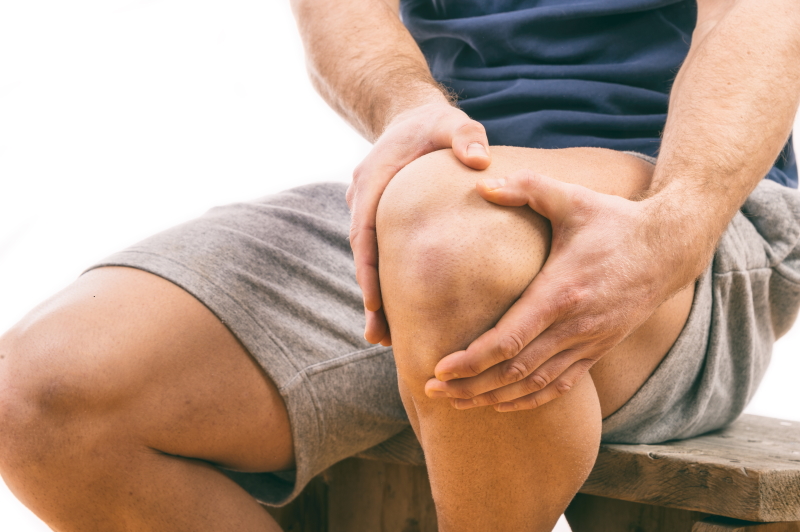
Knee clicking or popping is common, and it has several possible causes. The first thing to establish is whether the clicking is painful. Clicking with pain in the knee suggests a more concerning problem, while painless clicking usually has a harmless cause. So what causes knee clicking or popping, and when should you see a doctor?
The most common cause of knee clicking
Believe it or not, the commonest cause of knee clicking has nothing to do with damage to the knee.
Your knee is a large hinge joint lubricated by synovial fluid. Gas bubbles can form in that fluid, and as the knee bends and straightens, these bubbles burst — producing a click or pop. It’s the same sensation you get when you click your knuckles, or hear a click during a back stretch.
Contrary to popular opinion, repeated clicking or popping from bursting gas bubbles does not damage the joint, and does not increase your risk of arthritis.
Other causes of knee clicking
Clicking or popping can also come from other causes — some more concerning than others.
Patellofemoral pain (chondromalacia patellae)
Often called runner’s knee, this presents as pain at the front of the knee, and many people also notice clicking, popping, or cracking. We think irritation of the patellofemoral joint occurs because of poor tracking of the kneecap, overuse from excessive cycling or running, or a fall onto the kneecap.
Tendon snapping
Swelling of the tendons and tendon-like structures around the knee causes clicking or snapping. The commonest is the iliotibial band — a thick band of tissue running from the hip down the outside of the thigh to the knee. When it’s swollen, it rubs across the knee, causing a pop beneath the skin. If the knee is painful too, we call this iliotibial band syndrome.
Other tendons that click or snap include the medial hamstring tendons at the back of the knee, and — on the outside of the knee — the biceps femoris tendon and the popliteus tendon.
Knee plica

A plica is a thickened fold of the normal synovial lining of the knee joint. Plicae form during development and usually regress, but they persist into adulthood in a proportion of people. Sometimes a plica becomes inflamed, catching in the joint as the knee bends and straightens.
An inflamed knee plica causes pain, clicking, or catching, and symptoms usually occur on the inner side of the kneecap. The same thing happens in the elbow — see elbow plica syndrome.
Torn meniscus
The menisci provide cushioning and help protect the joint. A torn meniscus causes a mechanical click or catch as the knee moves back and forth. Sometimes the meniscus gets caught, producing popping or locking.
Knee arthritis
Degeneration of the articular cartilage is known as osteoarthritis. Uneven cartilage surfaces can produce noise with movement.
When to see a doctor about knee clicking
See a doctor if you have clicking and pain in the knee — your doctor will assess it and make a diagnosis.
Symptoms such as popping or locking should also be assessed even without pain. These mechanical symptoms can be an early warning of impending knee damage. Early treatment — weight management, knee strengthening, and orthotics — can stop that progression, and treatment always works better when directed at a specific diagnosis.
Seek prompt assessment if:
- The knee locks and you can’t fully straighten it, which can indicate a meniscal tear or a loose fragment in the joint
- The knee gives way, or feels unstable.
- There’s significant swelling, particularly if it came on rapidly.y
- The clicking followed a specific injury or twist
Frequently asked questions about knee clicking
How do I get my knee to stop clicking while walking?
First, you need a specific diagnosis, so see a doctor. Treatment for causes such as patellofemoral pain or knee arthritis includes knee strengthening exercises (squats, lunges, and crab walks with a Theraband), proper footwear and orthotics, soft tissue massage with a foam roller, and a knee brace. Brace options range from a simple knee sleeve to a bulkier brace with kneecap support.
Is cracking your knee bad for you?
Most cracking comes from bursting gas bubbles and isn’t a sign of anything wrong. Frequent cracking does not lead to more knee joint damage.
Is knee clicking a sign of arthritis?
It can be, but most knee cracking isn’t caused by joint damage or arthritis. Clicking that comes with pain, swelling, or stiffness is more likely to be significant — and worth assessing.
Why does my knee click when I squat or climb stairs?
Clicking during a deep squat or on stairs often comes from the patellofemoral joint, where the kneecap glides over the thigh bone under high load. Painless clicking in these positions is usually harmless. Clicking with pain at the front of the knee points to patellofemoral pain, and clicking on the outside of the knee during a squat can indicate a snapping tendon.
Should I worry about painless knee clicking?
Usually not. Painless clicking without swelling, locking, or giving way is very common and rarely signals a problem. Keep an eye on it, and get it checked if pain, swelling, or mechanical symptoms develop.
What’s the difference between clicking and locking?
Clicking is a noise or sensation as the knee moves and is often harmless. Locking means the knee physically jams,s and you can’t fully straighten it — which suggests something is caught inside the joint, such as a torn meniscus or a loose fragment. True locking always warrants assessment.
Final word from Sport Doctor London about knee clicking or popping
Knee popping or clicking is usually not a sign of joint damage — most of it comes from harmless gas bubbles. But if you have clicking with pain, or the knee locks or gives way, see your doctor for a specific diagnosis and targeted treatment to prevent further damage.
If you have knee clicking with pain, Dr Masci can assess you in London, including ultrasound in clinic. Contact the team here or call +44 (0) 203 488 0350.
Leave A Comment