
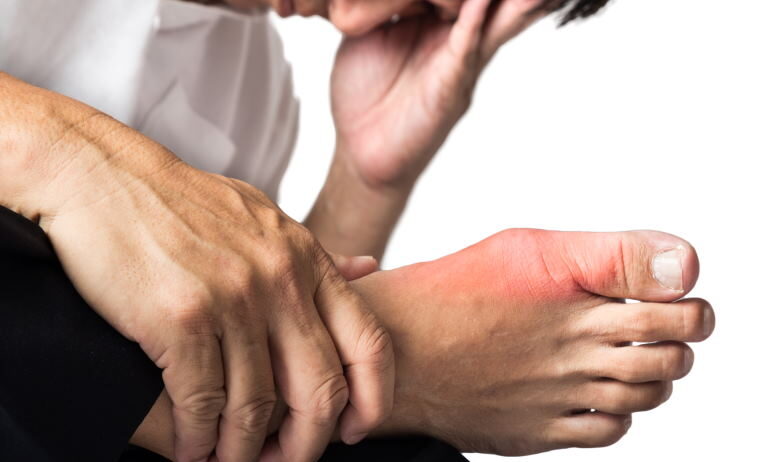
Gout is an inflammatory joint disease that commonly affects men in their 40s and 50s, sometimes younger. It causes severe pain and swelling, and most people want one thing during an attack — immediate relief. So what stops gout pain immediately, is a cortisone injection an option, and how do you get rid of gout for good?
This is the main gout guide. For gout in a specific joint, see gout in the knee; for the crystal arthritis that mimics it, see pseudogout.
What is gout?
Too much uric acid in the blood causes gout. Uric acid is a byproduct of the breakdown of purines — produced by the body, and also taken in through diet. As purines break down, uric acid crystals form and build up in joints. The big toe is the classic site, but the ankle, knee, and other joints can be affected, too.
Can you get gout in your shoulder?
Most gout affects the big toe or foot, but severe gout can affect the upper limbs — the shoulder, wrist, and finger. Uric acid levels must be high, and other inflammatory arthritis should be ruled out first.
What stops gout pain immediately?
You can take simple steps to ease gout pain straight away: apply ice, apply compression to the joint, and rest from sport, while staying well hydrated and avoiding alcohol. These help, but medication is usually what truly stops an acute attack fast.
- Anti-inflammatory tablets such as ibuprofen work quickly to relieve pain.
- Colchicine can stop gout pain in the first 24 hours. The dose is often one tablet three times a day, reduced to twice daily after a week as the pain settles. Limit it to 2–3 tablets a day to avoid stomach upset and diarrhoea.
The earlier you treat an attack, the milder and shorter it tends to be — so start treatment as soon as you feel one coming.
Can you take colchicine and ibuprofen together?
Yes. Both treat acute gout and work in different ways. Colchicine is often favoured for acute attacks, as it’s well tolerated and works quickly — but ibuprofen and other NSAIDs can cause side effects such as stomach ulcers, high blood pressure, or kidney problems.
Is a cortisone shot for gout an option?
Cortisone is a potent anti-inflammatory steroid that stops gout pain quickly. It can be taken by mouth, though side effects are common, so a cortisone injection into the inflamed joint is often more effective — a big toe or foot gout injection works well when pain is severe. We use ultrasound to guide the needle into the joint, which improves the effect. A cortisone shot often takes a few days to work, but given early in an attack, it can provide rapid relief.
What about PRP injections for gout?
PRP injections are reserved for exceptional cases. Like cortisone, PRP is anti-inflammatory, and its effect is probably better if the joint also has osteoarthritis. But its impact is less than cortisone’s, so we’d only consider PRP if the risks of cortisone are too high.
How to get rid of gout and prevent flare-ups
Stopping the pain is only half the job — preventing future attacks means lowering uric acid levels.
Lifestyle changes
Treat the lifestyle factors first: losing weight, reducing alcohol, and eating a healthy diet. A recent study found weight loss is the single most important factor — modifying diet and alcohol didn’t help unless excess weight was also addressed. So if you want to prevent attacks, weight loss should be the priority.
Diet: foods to avoid and choose
Foods that raise uric acid and are best limited include organ meats, sardines, anchovies, prawns, broad beans, and foods high in high-fructose corn syrup. Yeast-based foods, sugar-sweetened drinks, and alcohol also raise levels — wine is better than spirits or beer. Foods that lower uric acid include cherries, fruit and vegetables, low-fat dairy, and a vegetarian diet. Staying well hydrated (around 8 drinks a day) reduces the frequency of attacks, and 1 g of vitamin C daily is associated with lower uric acid levels.
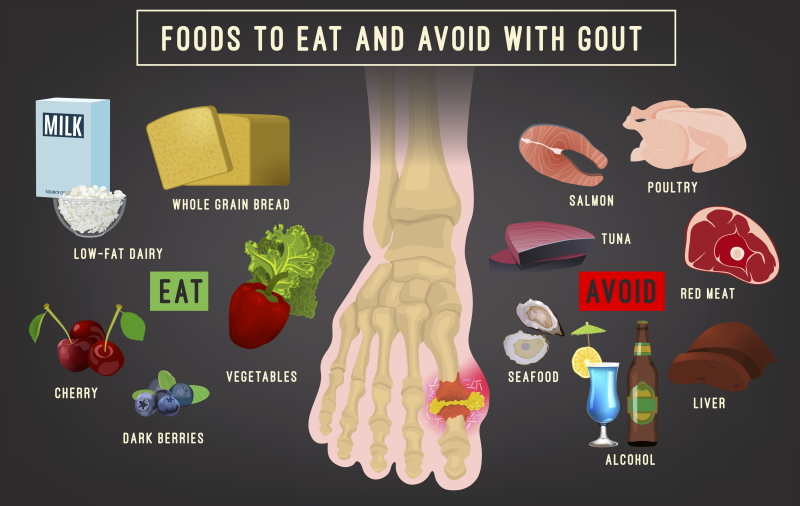
Foods that raise uric acid and are best limited include organ meats, sardines, anchovies, prawns, broad beans, and foods high in high-fructose corn syrup. Yeast-based foods, sugar-sweetened drinks, and alcohol also raise levels — wine is better than spirits or beer. Foods that lower uric acid include cherries, fruit and vegetables, low-fat dairy, and a vegetarian diet. Staying well hydrated (around 8 drinks a day) reduces the frequency of attacks, and 1 g of vitamin C daily is associated with lower uric acid levels.
Medication to lower uric acid
Your doctor may prescribe a uric-acid-lowering drug — most commonly allopurinol. It’s started only after an acute attack has settled, and is generally used when uric acid levels are high (usually above 500), or attacks recur. If allopurinol isn’t tolerated, febuxostat is an alternative. When starting allopurinol, you’ll usually also take colchicine (one tablet twice daily) for about four weeks to prevent a flare.
Does glucosamine help?
A study suggested regular glucosamine supplements reduced gout attacks by around 20% over 12 years — but only in women, not men.
Dos and don’ts for gout pain relief
- Do treat symptoms as soon as an attack starts — early treatment means a less painful episode.
- Do stay well hydrated and avoid alcohol during an acute attack.
- Don’t binge on high-purine foods, though a little in the diet is fine.
- Do treat recurrent gout with a preventative medication such as allopurinol, especially if uric acid is above 500.
Frequently asked questions about immediate gout pain relief
What stops gout pain immediately?
The fastest relief comes from medication — colchicine within the first 24 hours, or an anti-inflammatory such as ibuprofen — alongside ice, rest, and hydration. For a severe flare, an ultrasound-guided cortisone injection into the joint can settle it quickly.
How long does a gout attack last?
Treated early, an acute attack often settles within a few days. Left untreated, it can take weeks, with lingering low-grade swelling. Recurrence is common — over 60% have another attack within two years — which is why prevention matters.
How do I get rid of gout permanently?
There’s no instant cure, but lowering uric acid prevents attacks — through weight loss (the most important step), diet, reduced alcohol, and, where needed, a uric-acid-lowering drug such as allopurinol. The goal is a uric acid level of around 350 or below.
Is gout the same as pseudogout?
No. Calcium crystals, not uric acid, cause pseudogout. It affects older people and larger joints such as the knee, and isn’t affected by diet, so the prevention strategies differ.
Which joints does gout affect?
Most often the big toe, but also the knee, ankle, and foot — and, in severe cases, the wrist, finger, or shoulder. A single hot, swollen joint coming on over hours is the classic picture.
Final word from Sport Doctor London about immediate gout pain relief
Acute gout can mimic other MSK problems, and it doesn’t only affect the big toe — the ankle, knee, and upper limbs can all be involved. Early diagnosis and treatment are the key to fast relief, sometimes including a cortisone shot, while weight loss and uric-acid-lowering medication prevent it from coming back.
To book an assessment with Dr Masci in London, contact the team here or call +44 (0) 203 488 0350.
Thank you very helpful appreciate the help got gout on my hand very painful 😢
Thank you so much for providing public service information for the greater good. Despite needing to see a doctor, acquiring information is an important part of understanding the illness. Much appreciated!
Thanks
Very informative and helpful. Greatly appreciate the advice.
My sister suffers from gout pain. But I want to relieve her from this pain. So I recommended she take a colchicine dose which helped her to decrease her pain. I am thankful to you for sharing this advice.
This is by far, the best overall account of gout, its causes, recommendations for pain relief and lifestyle changes that I’ve seen in my years of research. I am an older male with other medical problems (heart, diabetic etc.) and have been experiencing severe gout breakouts for the past few years. My uric acid levels are far too high. Missing in this write-up are the side-effects of Colchicine which can be brutal. I get severe diarrhea for days which aggravate my hemorrhoids etc. My best advice, stop the evening cocktails and eat a cup of cherries each day.
Thanks Glen. yes you’re right about colchicine – I recommend limiting this medication to two to three a day to avoid intestinal side effects. Lorenzo
Take a Lemon and puree it in a food processor seed pith and rind all of it and eat a raw table spoon 3 times a day and it will stop gout in its tracks without medicine. at it works for me. and I get the gout really bad for years. Its super hard to eat for me so I chase it with a huge glass of water. It’s a miracle.
Thanks for your avice.
I am going to try this as I have had gout for nearly three months. I have been taking Allopurinol for 5 weeks – I still have pain and swelling. Lemons cannot hurt!!
Very important update, thanks for the information.