
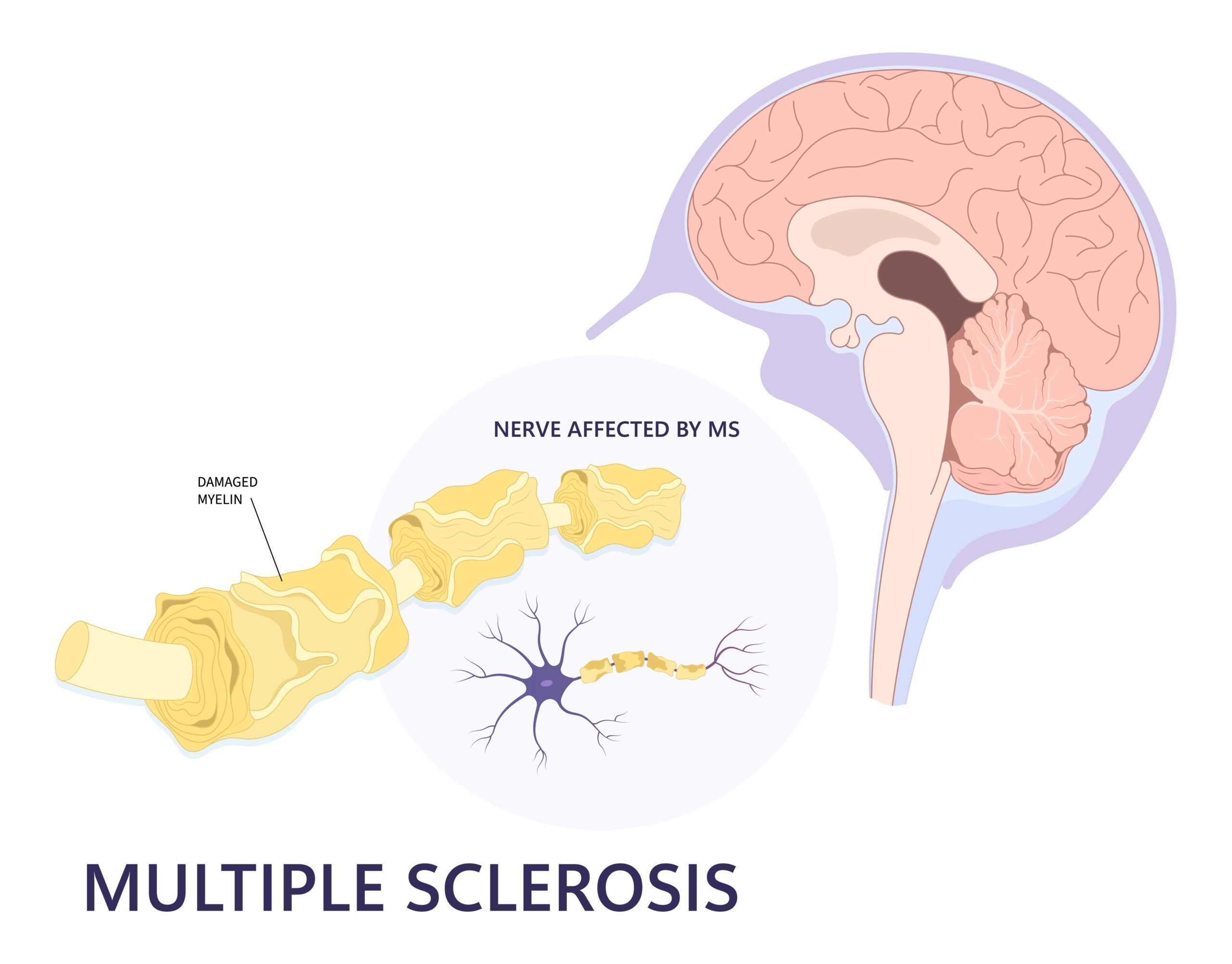
As a sports and exercise medicine doctor, I find that most of the numbness, tingling, and weakness we see are musculoskeletal in origin. Examples include a trapped nerve or a disc problem. But occasionally, symptoms that look like a sports injury turn out to have a neurological cause, and one of the important ones is multiple sclerosis (MS). Knowing the early signs of multiple sclerosis—and, crucially, how they differ from a sports injury—helps ensure the right people are seen by the right specialist at the right time.
What is multiple sclerosis?
Multiple sclerosis is a chronic condition in which the immune system mistakenly attacks the protective coating (myelin) around the nerves in the brain and spinal cord. This disrupts the messages travelling along those nerves, producing a wide range of possible symptoms. It usually begins in young adults, between about 20 and 40 years of age, and it’s roughly twice as common in women as in men. Most people with MS have a normal life expectancy, and treatments have improved considerably.
Because MS affects the central nervous system (the brain and spinal cord), its symptoms can appear anywhere in the body — which is exactly why they’re sometimes mistaken for a limb or joint problem.
Early signs of multiple sclerosis
MS affects people very differently, and early symptoms often come on, then settle again on their own, which is part of why they’re easy to overlook. Common early signs of multiple sclerosis include:
- Numbness or tingling — in the arms, legs, trunk, or face, often without any injury to explain it
- Weakness — commonly in the arms or legs
- Visual problems — painful loss or blurring of vision in one eye (optic neuritis), or double vision
- Balance and coordination problems — clumsiness, or unsteadiness when walking
- Muscle stiffness and spasms
- Dizziness or vertigo
- Bladder problems — urgency, or difficulty passing urine
- Fatigue — a heavy, disproportionate tiredness, mental or physical
A characteristic (though not universal) sign is Lhermitte’s sign — an electric-shock-like sensation running down the spine or into the limbs when you bend your neck forwards. Heat — a hot bath, a fever, or exercise in the heat — often makes MS symptoms temporarily worse, which is a useful clue.
How MS symptoms can mimic a sports injury — and how they differ
This is the heart of it. Several early signs of multiple sclerosis overlap with common sports and musculoskeletal problems. The differences are what matter. So, how do you tell if you have MS?
Numbness and tingling: MS or a trapped nerve?
A trapped or pinched nerve is a very common cause of numbness and tingling, and it’s usually the right explanation. But there are differences:
- A trapped nerve follows the territory of one nerve — a specific patch of skin, or a particular hand or foot — and often has a mechanical trigger (a posture, a movement, a specific injury).
- MS numbness tends not to respect a single nerve’s territory. It can affect a whole limb, both legs, one side of the body, or the trunk in a “band” — a pattern that doesn’t fit one peripheral nerve.
- Nerve symptoms with visual problems, bladder changes, or symptoms in more than one area at once point away from a simple trapped nerve.
Weakness: MS or an MSK problem?
Weakness from a local muscle, tendon, or nerve injury from the spine is usually painful, localised, and tied to the injured structure. MS weakness is often painless, can affect an entire limb or side, and may be accompanied by other neurological signs (brisk reflexes, increased tone, spasticity, or clonus). Weakness that doesn’t fit an injury or comes with numbness elsewhere warrants a neurological assessment.
Balance problems and clumsiness
Unsteadiness and incoordination (ataxia) from MS reflect the brain’s balance pathways, not the joints or ligaments. If someone’s balance is off without an ankle or knee injury to explain it — especially with other symptoms — that’s a neurological question, not an MSK one.
Fatigue
Fatigue is common after hard training or with overtraining, but MS fatigue is characteristically out of proportion to activity, and comes with other neurological symptoms. On its own, it’s rarely MS — but in the wrong pattern, it’s worth noting.
What else can cause these symptoms?
An important point from the medical literature: several conditions can mimic MS, which is exactly why a proper assessment matters. These include
- vitamin B12 deficiency
- thyroid disease
- other autoimmune inflammatory conditions (such as lupus or sarcoidosis),
- infections (such as HIV, syphilis and Lyme disease),
- small-vessel disease of the brain.
Some of these — like a compressive spinal problem, or vitamin deficiency — sit closer to a sports doctor’s world, which is another reason these symptoms are assessed carefully rather than assumed.
When should you see a doctor?
See your GP or a neurologist — rather than assuming it’s a sports injury — if you have: numbness, tingling, or weakness that doesn’t fit a single nerve or a specific injury; any visual problems (painful vision loss in one eye, or double vision); balance or coordination problems without an injury to explain them; an electric-shock sensation down the spine on bending the neck (Lhermitte’s sign); or several of these symptoms together, or symptoms that come and go over weeks. MS is diagnosed by a neurologist, usually with an MRI scan of the brain and spinal cord, so an early, accurate referral is what matters.
Most people who see a sports doctor with numbness or weakness have a musculoskeletal cause — and that’s usually good news. The role of a careful sports medicine assessment is partly to treat those MSK problems and partly to recognise the very small number that aren’t musculoskeletal and ensure they reach a neurologist promptly.
How is MS diagnosed?
There’s no single test for MS. A neurologist makes the diagnosis by combining the history, a neurological examination, and investigations — the most important being an MRI of the brain and spinal cord, which shows characteristic areas of scarring (plaques or lesions). Generally, the more lesions there are, the more likely the disease is due to MS. Also, contrast enhancement is more suggestive.
Sometimes other tests help, such as a lumbar puncture (examining the spinal fluid, which suggests MS if IgA CSF levels are elevated) or evoked-potential tests (measuring how quickly the nerves conduct signals). The diagnosis rests on showing that the condition has affected different parts of the central nervous system at different times — and on excluding the conditions that can mimic it.
Frequently asked questions about how to tell if you have MS
Can a trapped nerve be mistaken for MS?
It’s more often the other way around — MS symptoms get mistaken for a trapped nerve, because both cause numbness and tingling. The key difference is the pattern: a trapped nerve follows one nerve’s territory and often has a mechanical trigger, whereas numbness in MS tends to cross those boundaries — a whole limb, one side, or both legs — and may come with visual or bladder symptoms. When the pattern doesn’t fit a single nerve, it’s worth a neurological assessment.
Does numbness or tingling always mean something serious?
No — most numbness and tingling have a benign, musculoskeletal cause, commonly a trapped nerve, and settle with the right treatment. What raises concern is the company it keeps: numbness with visual problems, weakness, balance issues, bladder changes, symptoms in several areas at once, or symptoms that come and go over weeks. That combination is a reason to see a doctor rather than assume it’s an injury.
Can exercise or sport cause MS?
No. Exercise doesn’t cause MS, and staying physically active is actually important for people with MS. What can happen is that heat — including exercising in the heat, a hot bath, or a fever — temporarily worsens existing MS symptoms, which then settle as you cool down. That heat sensitivity is a recognised feature, not a sign that exercise is harmful.
I have numbness after training — should I worry about MS?
Usually not. Numbness that follows a specific activity, in a specific spot, and settles with rest is far more likely to be a trapped nerve or an overuse problem than MS. It becomes worth a neurological opinion if it doesn’t fit a single nerve, doesn’t settle, or comes with other symptoms such as visual changes, weakness, or balance problems. A sports medicine assessment can help sort out which it is.
Who diagnoses MS?
A neurologist — a doctor specialising in the brain and nervous system — diagnoses MS, usually with an MRI scan alongside the clinical assessment. A sports and exercise medicine doctor’s role here is to recognise early signs of multiple sclerosis, rather than musculoskeletal conditions, and to refer you promptly to the right specialist, rather than make the diagnosis.
Final word from Sport Doctor London about the early signs of multiple sclerosis
Most numbness, tingling, and weakness we see in sports medicine has a musculoskeletal cause — often a trapped nerve — and improves with the right treatment. But a small number of these symptoms are neurological-based, and multiple sclerosis is one of the important ones to recognise. The clues that point away from a simple sports injury are symptoms that don’t fit a single nerve, that come with visual or bladder changes or balance problems, or that appear in several areas or come and go over weeks. If that sounds like you, the right step isn’t to self-diagnose — it’s to see a neurologist for a proper assessment on how to tell if you have MS.
If you have unexplained numbness, tingling, or weakness and you’re not sure whether it’s a sports injury, Dr Masci can assess you in London and, where needed, refer you to the right specialist. Contact the team here or call +44 (0) 203 488 0350.
Leave A Comment