

Deep buttock pain is common in active people — and notoriously hard to pin down. The anatomy of the buttock is complex, with overlapping muscles, nerves, joints, and tendons, so glute pain is misdiagnosed more often than almost any other sports complaint. Dr Masci assesses deep buttock pain at his London clinics, using examination, imaging, and diagnostic injections to find the true cause.
So what are the possible causes of deep buttock pain, and how do we reach a correct diagnosis?
Buttock anatomy: why gluteal pain is complicated
Several structures stack in a small space. Superficially, the gluteus maximus and medius attach the pelvis to the thigh bone. Deeper, the gluteus minimus, piriformis, and small hip rotators form the floor. The sciatic nerve — the body’s largest — passes beneath the piriformis into the upper thigh. The back of the hip joint hides under the buttock muscles, and the sacroiliac joint sits above and inside. Deeper still lie the pelvic organs, which can refer pain into the buttocks. Any of these can hurt — and several can hurt at once.
Common causes of deep buttock pain
Hamstring origin tendonitis
The hamstring tendons insert onto the ischial tuberosity, and overload can cause high hamstring tendinopathy or a proximal hamstring tendon tear. The giveaway pattern: buttock pain with sitting, driving, and running, a tender sitting bone, and pain on resisted hamstring tests. Swollen tendons can also irritate the nearby sciatic nerve, adding thigh pain. Treatment needs a dedicated programme — start with our proximal hamstring rehab guide.
Sacroiliac joint pain
The sacroiliac joints can cause upper buttock pain near the spine, due to wear, a fall onto the buttocks, or inflammatory arthritis. The joint is tender, and specific SI joint tests confirm it.
Sciatica from the lumbar spine
Pinched lumbar nerves usually radiate pain down the leg, but sometimes the pain stays in the buttocks alone. Lower back movement reproduces the gluteal pain, and tests such as the slump are positive.
Hip arthritis
Few people realise that the back of the hip joint sits deep within the buttocks. Hip arthritis, therefore, radiates into the glutes, and moving the hip joint reproduces the pain.
Less common causes of gluteal pain
Piriformis syndrome
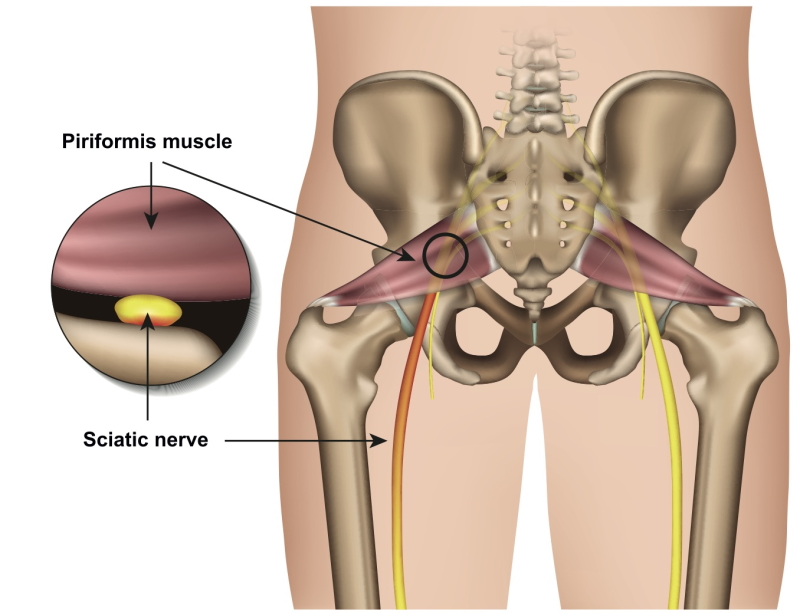
A tight piriformis muscle can trap the sciatic nerve, causing buttock pain that may travel to the lower thigh. Special tests identify it.
Deep gluteal syndrome
Deep gluteal syndrome is the umbrella term for sciatic nerve entrapment anywhere in the buttocks, by the piriformis, the swollen hamstring tendons, or other deep muscles.
Ischiofemoral impingement
Ischiofemoral impingement pinches the quadratus femoris muscle between the pelvis and thigh bone. It typically hurts when walking, and an MRI confirms muscle swelling.
Pudendal nerve entrapment
The pudendal nerve runs close to the sitting bone. Entrapment causes lower buttock pain radiating to the inner groin, perianal skin, or genitalia. Consider it once common causes are excluded.
Cluneal nerve entrapment
The cluneal nerves supply the skin over the buttocks. Entrapment causes upper buttock pain radiating towards the hamstring. It is a diagnosis of exclusion, confirmed with a nerve block.
How do we diagnose deep buttock pain?
The history gives the first clues: sitting and driving pain points to hamstring tendonitis; walking pain suggests ischiofemoral impingement; upper buttock pain near the spine implicates the sacroiliac joint. Examination then tests each structure— the spine, SI joint, hip joint, hamstring origin, and the piriformis.
Imaging confirms the suspicion. X-rays and ultrasound assess the hip, SI joints, and pelvic tendons, but a good-quality MRI is the most useful single test for gluteal pain. Nerve studies occasionally separate spinal from buttock causes.
Diagnostic injections are often the decisive step. An ultrasound-guided injection of local anaesthetic into the suspected structure — the hip joint, sacroiliac joint, hamstring origin, piriformis, or trochanteric bursa — confirms the diagnosis when the pain disappears. It treats it when combined with cortisone or PRP. Dr Masci performs these as one-stop visits: assessment, diagnostic ultrasound, and injection in a single appointment.
Surgery is the last resort for buttock pain — it carries real risks of infection and worse pain, and almost all cases settle without it.
Frequently asked questions about deep buttock pain
Why does my buttock hurt when I sit?
Sitting pain strongly suggests hamstring origin tendonitis — the sitting bone bears your weight directly onto the swollen tendon. Less commonly, pudendal or cluneal nerve entrapment causes pain with sitting. An MRI usually separates the causes.
Can buttock pain come from the hip?
Yes. The back of the hip joint sits deep within the buttock muscles, so hip arthritis and hip impingement frequently masquerade as gluteal pain. Moving the hip during examination reveals the connection.
When should I see a doctor about gluteal pain?
See a doctor if the pain persists beyond a few weeks, disturbs sleep, radiates down the leg, or causes numbness or tingling. Earlier assessment shortens the road to the right treatment — most causes of deep buttock pain respond well once correctly diagnosed.
Final word from Sport Doctor London on deep buttock pain
Deep buttock pain is complex, and misdiagnosis is the rule rather than the exception. See an experienced sports doctor who can examine each candidate’s structure, obtain appropriate imaging, and use diagnostic injections where needed. Avoid surgery in almost all cases.
To book a one-stop buttock pain assessment with Dr Masci in London, contact his team here or call +44 (0) 203 488 0350.
Hi, do you carry out investigations into trigger point pain referred into the gluteal muscles? Also do you carry out trigger point injections? Thanks.
Hi Anne, I used to perform trigger point injections when I trained in Australia. But now I rarely do them. However, for non-specific buttock pain, I think trigger point injections could be useful in some cases. Lorenzo
Hello
Had butt pain since fall in 2018
Nobody has got to the (pardon the pun) bottom if it
Been diagnosed hesitantly by specialist with arthritis.
I have always believed i damaged my Piriformis, but no doctors or specialist wanted to listen.
Hi Mike, yes, buttock pain can be complex. Sometimes injections can help with diagnosis and therapy. LM
I can’t sit on my butt. My right buttocks literally feel like it slide into my anus. I feel like I’m sitting on a balloon half filled. It causes radiating pain in my butt and the skin. I had necrosis of right hip and hip was replaced and I still need to get the left hip done. What could be causing this? I’m very depressed. I
You might have nerve damage : https://sportdoctorlondon.com/overview-of-groin-nerve-pain/
Of course, you need to speak to your MSK doctor.
Hi, I have buttlock pain for 50 days now I did an x ray and some blood tests didn’t find anything, in the beginning the pain was on both sides now I can say it is concentrated on one side, when I sit more that 1 hour I start feeling it, not an acute pain but enough to recognize it, do I need an MRI what this might be
Hi Abdel,
I definitely recommend an MRI scan – if you have sitting pain, hamstring origin tendonitis is a possibility
https://sportdoctorlondon.com/high-hamstring-tendinopathy/
Other possibilities include sacroiliac joint pain
https://sportdoctorlondon.com/sacroiliac-joint-injection/
Lorenzo
Hello, I run in athletics and have been experiencing pain in my glutes for a year. It occurs when I sit for long periods of time and when I run. It first started with my right glute, and two months later the pain was in both (but the pain on the right side is always worse).
Some time later, my hip and sacroiliac joint started popping, but my hip more frequently.
Lately, I’ve been experiencing a tingling sensation in my right leg when I put weight on it, for example when doing unilateral Romanian deadlifts.
I’ve had several tests done, and I don’t have a herniated disc or a stress fracture, just a slight lumbar hyperlordosis.
Do you think you could give me your opinion?
theres a number of possibilities – but based on your description, you could have senstivity of the sciatic nerve in the buttock. We call this condition deep gluteal syndrome. See this blog for further information: https://sportdoctorlondon.com/deep-gluteal-syndrome/
I suggest you see a sports or PM+R doctor (if based in US).