

Your hand and wrist are a complex arrangement of bones, joints, tendons, nerves, and muscles that work together for fine, coordinated movement. Wrist and hand arthritis becomes more common with age, and can be painful and disabling. A cortisone shot in the hand for arthritis is one option in more difficult cases.
Anatomy of the wrist and hand
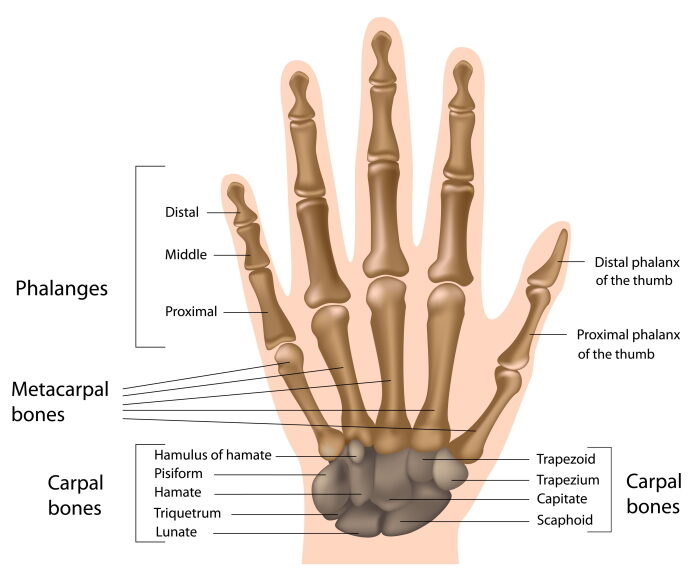
There are 27 bones in the wrist and hand — the carpals, metacarpals, and phalanges. Cartilage covers the joint surfaces, allowing smooth, pain-free movement. In arthritis, that cartilage is lost, leading to bone-on-bone contact and pain with movement.
Symptoms of wrist and hand arthritis
The first symptom is usually pain after heavy use — a full day of gardening, or a game of tennis. As arthritis progresses, simple activities such as opening a door or typing become painful, and morning stiffness is common. Other features include swelling, restricted movement, warmth, and firm nodules on the fingers — in osteoarthritis, these are Bouchard’s and Heberden’s nodes.
It’s important to distinguish osteoarthritis from inflammatory arthritis such as rheumatoid disease. Rheumatoid changes include swelling of the knuckle (MCP) joints, drifting of the fingers away from the thumb, and nail changes.
How do we diagnose wrist and hand arthritis?
We use three types of assessment:
- Clinical examination — examining and feeling the hand and wrist joints gives important clues
- X-rays — show the type and severity of arthritis; ultrasound or MRI can add detail
- Blood tests — often crucial where inflammatory arthritis is suspected
Treatment options, including a cortisone shot in the hand
The goal is to reduce pain and preserve function. Options include:
- Lifestyle adjustments — small changes to daily activities can meaningfully reduce pain
- Wrist and finger splints — support that allows simple tasks without pain
- Hand therapy — a therapist guides exercises, and simple hand devices keep the joints mobile and build grip strength
- Topical medication — ibuprofen or Flexiseq gel applied to the sore joints gives good relief
- A cortisone shot in the hand — reduces pain and improves mobility for a few months
- Surgery — such as wrist or finger fusion, as a last resort
More about a cortisone shot in the hand for arthritis
Cortisone is a potent anti-inflammatory that reduces arthritis pain. It isn’t right for everyone, though, and it’s important to be aware of the potential risks.
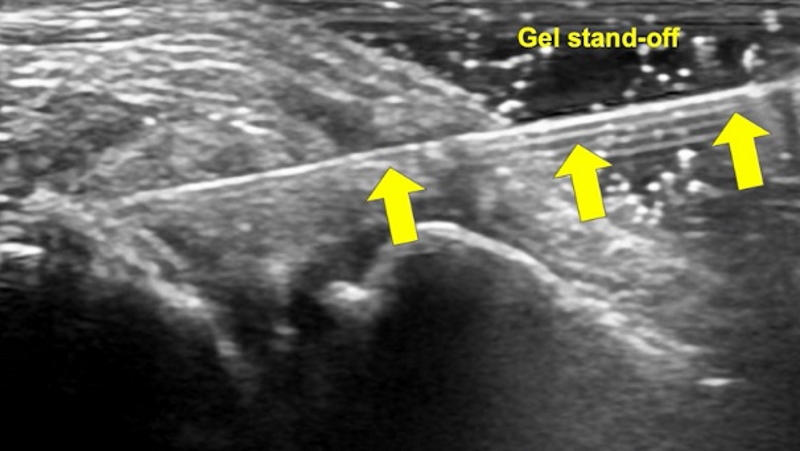
We advise giving cortisone injections under ultrasound guidance to improve accuracy and reduce side effects such as skin thinning and tendon damage. Ultrasound lets us direct the needle precisely into a small wrist or finger joint — which matters a great deal in the hand, where the joints are small, and the skin is thin. For more, see our guides to the side effects and how long a cortisone shot takes to work.
Are there other injection options for hand arthritis?
Yes, though the evidence in the hand and wrist is more limited.
Hyaluronic acid occurs naturally in joints, and injecting it can ease pain and may act as a lubricant. Platelet-rich plasma (PRP) is prepared from your own blood and injected into the joint. The evidence for PRP is good in knee arthritis but limited in the hand — though some doctors use it for people who want to avoid surgery.
How much does a cortisone injection in the hand cost?
Dr Masci injects at a one-stop appointment — consultation, diagnostic ultrasound, and the injection in a single visit. At the Chelsea clinic (the most cost-effective location), a consultation with an ultrasound-guided cortisone injection is £400; other clinic locations cost more. See the full one-stop injection fees here, along with our clinic locations. He also uses tiny needles for a hand arthritis injection, meaning pain is minimal.
Frequently asked questions about a cortisone injection in the hand
Does a cortisone shot in the hand hurt?
The hand can be a slightly more sensitive area to inject than a large joint, but we use a fine needle and ultrasound guidance to be as accurate — and as quick — as possible. Some soreness for a day or two afterwards is normal. Dr Masci uses tiny needles for hand arthritis injections, meaning pain is minimal.
How long does a cortisone shot in the hand last?
Typically a few months, though it varies by joint and the severity of arthritis. Cortisone controls the pain rather than curing the arthritis, so it’s best used alongside splinting, hand therapy, and activity changes.
Which hand and finger joints can be injected?
The wrist, the thumb base (a very common site), the knuckle (MCP) joints, and the finger joints can all be injected. Ultrasound guidance is especially valuable in the small finger joints, where accuracy is difficult by feel alone. For the thumb specifically, see our page on thumb joint arthritis injections.
How many cortisone shots can I have in my hand?
We use them sparingly. Repeated cortisone in the same small joint can, over time, affect the surrounding tissue, so we space injections out and combine them with other treatments rather than relying on cortisone alone.
Is a cortisone shot right for everyone with hand arthritis?
No. It suits painful flares and more difficult cases, but it isn’t for everyone. The right approach depends on the type of arthritis, which joints are involved, and how you’re affected — which is why an assessment comes first.
Final word from Sport Doctor London about a cortisone shot in the hand
Wrist and hand arthritis is a common part of ageing. We treat it with a combination of hand therapy, topical anti-inflammatories, and — in more difficult cases — a cortisone injection. We recommend ultrasound-guided injections to improve accuracy and reduce side effects. Make sure whoever performs your injection is medically qualified and experienced with ultrasound.
If you have painful hand or wrist arthritis, Dr Masci can assess you in London, including ultrasound in clinic. Contact the team here or call +44 (0) 203 488 0350.
My fingers become claw like lacking flexibility
And my nails don’t grow making difficult to
Pick up things I drop things a lot. Will cortisone
Shots help ?
it depends on the cause. I’d suggest you see an experienced doctor to assess and treat.