

One of the more common gym injuries is biceps tendonitis of the elbow. Excessive exercise or overload can cause swelling of the biceps tendon — distal biceps tendonitis. So how does pain in the biceps tendon at the elbow present, and what can you do about it?
What is biceps tendonitis of the elbow?
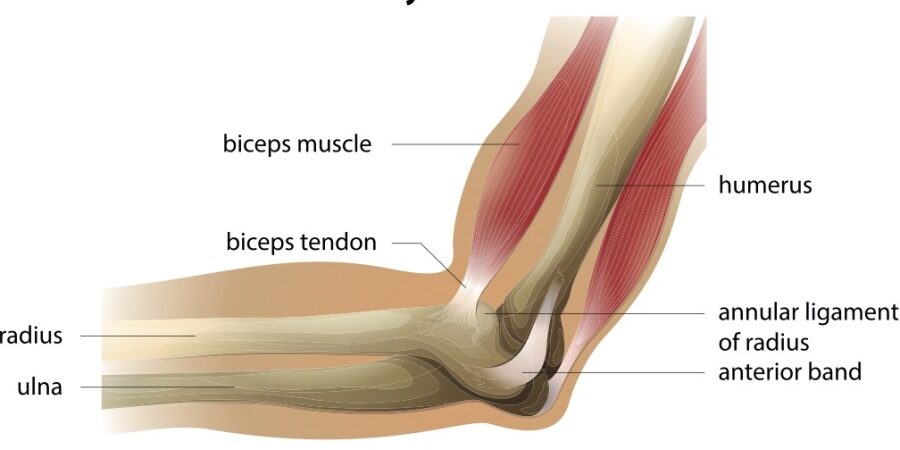
The biceps muscle sits at the front of the upper arm. As it passes the elbow, it forms a strong tendon that attaches to the radius. The biceps have two jobs: bending the elbow and turning the wrist outwards (so it’s essential for biceps curls, manual labour, and using a screwdriver).
Overloading this tendon causes pain and swelling where it attaches at the elbow — a condition called distal biceps tendonitis.
How do you know you have distal biceps tendonitis?
Heavy pulling exercises — biceps curls or pull-ups on a bar — stress the lower biceps tendon, causing swelling known as distal biceps tendonitis or lower biceps tendon pain.
Common symptoms include:
- Sharp pain or a dull ache at the front of the elbow, or just below it
- Pain and weakness after pulling exercises or repeated manual work
- A tender spot in the elbow just below the biceps
Tennis elbow or biceps tendonitis: how can you tell?
Biceps tendonitis is different from tennis elbow, and from the other tendon injuries on the inside and outside of the elbow — and they can be hard to tell apart. A careful examination is key: tennis elbow causes pain at the bony point on the outer elbow, whereas lower biceps tendonitis is felt more centrally, at the front. Ultrasound or MRI helps confirm the diagnosis when the diagnosis is unclear.
Can you rupture your distal biceps tendon?
Yes, though a complete tear at the elbow is uncommon. Ruptures happen when a sudden, heavy load is applied to a bent elbow — for example, a rugby tackle, or catching or lifting a heavy barbell. People often report a pop or crack, followed by severe pain and weakness. The biceps muscle then changes shape, bunching up into a “Popeye” appearance, with bruising and swelling over the next few days.
Sometimes the tendon only partially ruptures, which can mimic lower biceps tendonitis. Because the treatment differs, it’s essential to recognise a distal biceps tendon tear when it occurs alongside tendonitis.
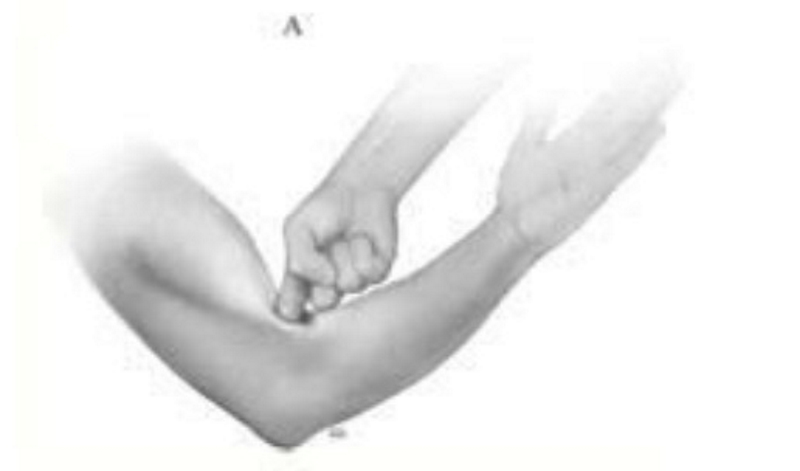
We carefully examine anyone we suspect has a biceps tendon tear. The hook test is often used: we hook an index finger under the biceps tendon near the elbow. If we can’t feel the tendon, the test is positive — meaning the tendon is torn.
Distal biceps tendonitis treatment
Most cases of lower biceps tendonitis settle with conservative treatment.
A short course of anti-inflammatories such as ibuprofen can ease the pain. The most important step is modifying your gym exercises — for example, switching from biceps curls to hammer curls, or from pull-ups to lat pulldowns, and changing the grip on pulling exercises from palm-down to palm-up. Strengthening the biceps helps: start with a lighter weight and increase it gradually, which builds the tendon’s capacity and reduces lower biceps pain.
What if exercise doesn’t fix biceps tendonitis at the elbow?
In complex cases, we consider injections to reduce tendon swelling and stimulate healing. Dr Masci has written a scientific paper on injections for tendonitis. There are several options for distal biceps tendonitis.
Cortisone — used with caution. Cortisone is a potent anti-inflammatory, but there’s evidence it can weaken tendons and raise the risk of rupture. So if it’s used at all, it must be done under ultrasound to avoid injecting into the distal biceps tendon — and never into a tendon tear.
Needle tenotomy (fenestration) is a lower-risk, often more useful option. Under local anaesthetic, we pass a fine needle through the tendon several times. These tiny micro-injuries are thought to trigger healing and remodelling.
PRP (platelet-rich plasma) is used in some cases. We take blood from a vein, spin it to concentrate the platelets, and inject the platelet-rich plasma into and around the tendon to stimulate healing.
Partial biceps tendon tear: how is it treated?
A full-thickness tear of the biceps tendon causes a major loss of power and needs surgery, and outcomes are better when surgery is done within three weeks of the injury.
A partial tear is more nuanced. Sometimes a scan reports the tendon as “partially torn” when, in fact, one of the two tendon heads (short or long) is completely torn — and in those cases, we usually recommend a repair. Some surgeons instead trial conservative treatment with rehab and/or PRP before considering surgery. For a genuine partial tear, treatment is similar to that for tendonitis.
Frequently asked questions about biceps tendonitis at the elbow
How long does distal biceps tendonitis take to heal?
Many cases settle over several weeks with load modification and progressive strengthening. A partial tear takes longer — generally around 3–4 months. Pushing back into heavy pulling too soon tends to prolong it.
Can I keep training with biceps tendonitis at the elbow?
Often yes, with modification. Low-level, stable pain is usually acceptable, but reduce the aggravating loads — swap pull-ups for lighter lat pulldowns so you can control the load, and use lighter isolated biceps curls to load the tendon gradually. Avoid pushing into sharp or worsening pain.
Will biceps tendonitis lead to a tendon rupture?
It’s unlikely on its own. The main things that raise rupture risk are a cortisone injection into the tendon and, possibly, anabolic steroid use. Managed sensibly with load modification, tendonitis doesn’t usually progress to a tear.
I do grappling / martial arts — how do I manage the pulling load?
Grappling sports (judo, jiu-jitsu) place heavy loads on the biceps tendon through gripping and pulling. The same principles apply: reduce training volume during a flare, build tendon strength with graded curls, and modify or limit the most provocative pulling until symptoms settle.
Could my forearm (brachioradialis) pain be from biceps tendonitis?
It can. Pain in the upper forearm sometimes arises from the distal biceps tendon and responds to the same approach — rehab and PRP in stubborn cases.
Does a strap or brace help biceps tendonitis at the elbow?
In our experience, straps to the elbow aren’t particularly effective for this. Load modification and progressive strengthening are far more useful.
Final word from Sport Doctor London about distal biceps tendonitis
Distal biceps tendonitis is a common cause of elbow pain in gym-goers, and simple measures — load modification and progressive strengthening — settle most cases. Where they don’t, options such as needle tenotomy or PRP can help, while cortisone is used with caution. The key is an accurate diagnosis, especially to distinguish tendonitis from a partial tear.
To book an elbow assessment with Dr Masci in London, including an ultrasound in the clinic, contact the team here or call +44 (0) 203 488 0350.
Other elbow conditions:
- Common elbow, hand, and wrist conditions
- Tennis elbow
- CrossFit elbow injuries
- Elbow plica syndrome
- Snapping elbow syndrome
- Tendon injection
Hi dear Dr.
I have a partial distal biceps tear, please guide me how to treat it without surgery, I am coach of powerlifting and need my power , I have studied about kinds of distal biceps tear and i know that the best way is surgery ,but I want to treat it without surgery with the help of you and sport , I would be gradeful to hear from you, thank you MN
Hi, It’s hard to give you specifics without seeing you and your images. You need a combination of slow resistance +/- injections – needle fenestration or PRP.
What is the expected recovery time for a partial tear? Would it speed up with prp therapy
Generally, partial tears take longer to heal. As a general rule, 3-4 months.
We’re not sure if PRP changes or accelerates recovery.
LM
Hello I’m John, I recently injured my distal bicep tendon. And was wondering if that causes swelling of veins in the area
probably not.
Thank you so much for your informative blog. I’ve had elbow pain for 3 months and my doctor has been unable to diagnose it. I’ll now go to her with information from your blog. Thank you.
Thanks, James for your comment. Good luck with getting over your injury.
I’ve had the distal bicep tendinitis for about 4 years. I can work through it at the gym except pull-ups. Could this be a life long injury I’ll live with? And could this lead to a year if I continue to work through the pain. I’m 32 yo male.
unlikely to tear unless 1) you have a cortisone injection or 2) use anabolic steroid (although the link between anabolics and tendon tears is tenuous). low-level ‘stable’ pain is ok. See blog on tendon pain and exercise
https://sportdoctorlondon.com/tendonitis-specialist/
Thank you for your blog, I like so many find your information very helpful..
I have had distal bicep tendinitis from progressively doing more and more pull ups. I am stretching my wrist out in a concentric and essentric movement without any major benefits.
However, would it help if I strapped my lower bicep tendon to relieve the pain?
Hi Hedley,
I suggest avoiding pull-ups and changing to lighter lat pull-downs – so you can control the load more. I’d also perform lighter isolated biceps curls to add load to your biceps tendon. I don’t find straps to the elbow particularly effective.
LM
Thank you so much for this insightful information. Recently got back into Judo and jiu jitsu and noticed this pain inside my elbow after randori and rolling. Was extremely worse and dilapidating following a full day of participating in a competition. I am my late 30’s and need martial arts to keep fit and to destress. Any advice on how to manage the condition for someone in grappling martial arts which involves a lot of grabbing and pulling. Many thanks, Kay
Thank you! I have exactly this stuff and it’s not torn, it’s just red and there’s inflammation. This article is the best I’ve found so far (and I’ve read a LOT, trust me).
thank you. I try my best to be objective and unbiased.
My non dominant AC has what feels like 2-3 very palpable tendons at full extension. There is slight pain/weakness at the site and prior to this appearing, my bicep was sore for a week when trying to extend. After reading your article I feel rest, NSAIDS, and then slow strengthening should resolve it. What would be a sign that I should be more concerned and have an in person consult?
Your article was the most thorough and informative I have found, thanks!
Thanks for your comments. I’d see a practitioner if your pain doesn’t settle with simple treatments, as I discuss in the blog.
Regards
Lorenzo
Hi there, Reading you blog has some great interesting points and information. I have inflammation in brachoradialis (forearm) and bicep. Would this be tendonitis and can this be treated with PRP therapy? This even gets inflamed with light weights however I want to get back into strength training and slowly push heavy weights agin.
Hi Dan,
I suspect your pain in the brachioradialis is arising from biceps tendonitis – so yes, it can be treated with PRP when combined with rehab.
Lorenzo