
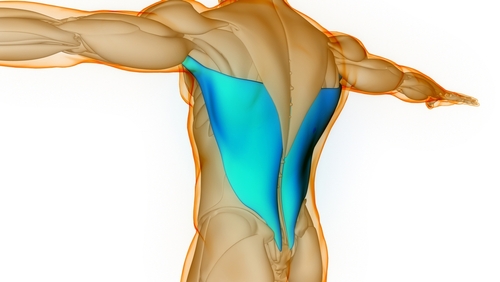
The latissimus dorsi — the “lat” — is the large back muscle that powers pulling movements. Lat injuries are uncommon, but they’re increasingly seen with CrossFit, weight training, throwing, water skiing and gymnastics. The most important thing about a lat injury is where it occurs along the muscle because that determines how it’s treated. So what causes lat pain, how do we tell these lat strains apart, and how do we manage them?
What is the latissimus dorsi, and what does it do?
The latissimus dorsi is one of the body’s broadest muscles. It originates widely across the lower back—the lower thoracic and lumbar spine, the lower ribs, and the pelvis. All those fibres funnel together into a single tendon that wraps around and attaches to the upper arm bone. The insertion is tucked in the armpit between the axillary muscles.
Its job is to pull the arm down and back, rotate it inward, and pull the body up toward a fixed arm. Think pull-ups, lat pulldowns, a swim stroke, or hauling yourself over a bar.
What causes a lat strain?
A pulled latissimus dorsi typically happens with a resisted pull action. The muscle contracts hard while it’s under load and stretch, usually with the arm overhead or extended. Recognised triggers include:
- CrossFit “muscle ups” and pull-ups
- Weight training — snatches, deadlifts, rows, and pulldowns
- Throwing sports — baseball pitchers are a classic group.
- Racquet sports, swimming, gymnastics, rock climbing, and track starts — the forceful arm pulldown from the blocks can tear it
- A fall onto an outstretched arm, catching the body against a sudden load
Symptoms of a lat pain and injury
The classic presentation is a sudden problem in the armpit and the outside of the back during a heavy pull:
- A sudden tearing, burning, or popping sensation in the armpit, sometimes with an audible “pop” or “crunch”
- Pain and swelling in the armpit and along the side of the back
- Bruising in the armpit or side
- Weakness pulling the arm down and back, or rotating it inward — for example, difficulty with pull-ups or throwing.
- Sometimes a visible or palpable lump where the torn muscle has bunched up
Shoulder movement is often close to normal, because other muscles compensate.
The key question in lat pain: where is the tear?
Where the injury sits determines the treatment. Lat injuries fall into a few categories:
- Intramuscular strain — a tear within the muscle belly itself. These generally heal well with conservative treatment.
- Myotendinous junction (MTJ) strain/tear — a tear where the muscle transitions into the tendon. This is a common site, and even high-grade MTJ tears are usually managed conservatively with good results.
- Tendon injury or avulsion — a tear of the tendon itself, or where the tendon pulls off its attachment on the humerus. This is the category where surgery is more likely to be considered, particularly in young active people.
Why this distinction matters: muscle and myotendinous injuries have an excellent track record with non-surgical treatment, whereas tendon avulsions are the ones where surgery is debated. You can’t reliably tell these apart with assessment, which is why imaging is central.
How is a lat strain diagnosed?
Imaging both confirms the injury and locates it:
- MRI is the imaging modality of choice. It shows exactly where the tear is (muscle, MTJ, or tendon), how severe it is, how far the torn ends have pulled apart (retraction), and whether neighbouring muscles are involved.
- Ultrasound shows the tear and any gap or hematoma in real time. It’s quick and well tolerated, though it offers a little less information than MRI.
How is a lat strain treated?
Treatment of latissimus dorsi pain depends on the injury’s location and the patient’s demands.
Conservative treatment — the mainstay
Most lat injuries, especially muscle-belly and myotendinous tears, are treated without surgery, with good outcomes even in serious tears and in athletes.
- Early relative rest and activity modification—avoiding aggravating pulls, with ice and pain relief.
- A progressive physical therapy program — restoring range of motion first, then gradually rebuilding back strength.
- A graded return to loading and sport
Recovery with conservative treatment typically takes a few weeks to a few months, depending on severity. In the reported cases, a track athlete with an intramuscular tear returned within about eight weeks. A CrossFit athlete with a high-grade myotendinous tear returned to training within about three months.
When is surgery considered?
Surgery for a pulled latissimus dorsi is mainly reserved for tendon avulsions in high-demand athletes who need to restore maximum strength and anatomy. Even here it’s debated, and many such injuries are still managed without surgery. For the recreational athlete, the surrounding muscles usually compensate well enough that surgery is rarely needed. When a tear heals slowly, other treatments such as PRP (platelet-rich plasma) are sometimes considered for the tendon component.
Overall: most pulled latissimus dorsi injuries do well without surgery—the decision hinges on the location (muscle/MTJ vs tendon avulsion), the severity, and how much strength the athlete needs to regain.
Recovery and getting back to sport with a pulled latissimus dorsi
Even after a good recovery, many people have a small residual difference—a mild strength deficit or a slight change in the muscle’s contour — which is usually of little consequence for a recreational athlete because the surrounding muscles compensate. For an elite athlete, though, even a small loss of pulling power can matter, which is why surgery is sometimes considered. A progressive return — rather than rushing back to the movement that caused it — is what protects against re-injury.
Frequently asked questions about lat pain
What does a pulled latissimus dorsi feel like?
Usually a sudden tearing, burning, or popping sensation in the armpit or side of the back during a heavy pulling movement. This is followed by pain, swelling, sometimes bruising, and weakness in pulling the arm down and back. Shoulder movement is often surprisingly normal because other muscles take over. A lump in the armpit or back can appear where the torn muscle bunches up.
How do I know if I’ve torn the muscle or the tendon in lat pain?
Usually, you can’t tell from symptoms alone. This distinction really matters, because it changes the treatment. Muscle and muscle-tendon-junction tears usually heal well without surgery. But a tendon avulsion (the tendon pulling off the bone) is the type where surgery may be considered. An MRI shows exactly where the tear is and how severe it is.
Does a torn lat need surgery?
Usually not. Most lat injuries are treated successfully without surgery, even in high-level athletes, because the surrounding muscles compensate well. Surgery is considered for tendon avulsions in high-demand athletes who need to restore maximum strength. It’s a decision made after imaging, based on the tear’s location and severity and the athlete’s needs.
How long does lat pain take to heal?
Healing time generally varies with location and severity. Milder muscle strains can settle in a few weeks; more significant muscle or myotendinous tears typically take one to three months to return to sport with a graded program. Surgically treated tendon avulsions take longer — often four to six months. A small residual strength difference can persist but rarely matters for recreational activity.
Should I get a lump in my armpit or back checked?
Yes. While a lump after a sudden pulling injury is often just the bunched-up torn muscle, a new lump in the armpit or back should be imaged. A torn lat can mimic a mass and be mistaken for a tumour or swollen glands. Imaging confirms the diagnosis and rules out other causes, so it’s worth doing.
Final word from Sport Doctor London about lat pain
Latissimus dorsi injuries are an uncommon but increasingly recognised cause of armpit and back pain in athletes. The single most important question is where the injury sits. Muscle belly and muscle-tendon tears respond well to rehab, while tendon avulsions might need surgery. Imaging answers that question and guides treatment.
If you have lat pain, weakness, or a lump after a pulling injury, Dr Masci can assess you in London, including in-clinic ultrasound, and arrange the right imaging. Contact the team here or call +44 (0) 203 488 0350.
Leave A Comment